Short Term Relief: Clinician Vetted Kinesio Tape for Adult Knee Pain
Kinesio tape can ease knee pain modestly and short-term, particularly for patellofemoral pain syndrome and mild osteoarthritis, and it works best alongside an exercise program rather than by itself. Think of it as a bridge to movement, not a fix. If your pain is severe, worsening, or comes with locking or swelling, tape is no substitute for a knee pain chiropractor clinical exam. For everyone else, a self-applied patellar strip or a session with a clinician for tailored kinesiology taping is a reasonable place to start.
TL;DR:
- Kinesio tape combined with exercise can significantly reduce pain and improve knee function in patellofemoral pain syndrome when used for more than four weeks.
- For knee osteoarthritis, kinesio tape offers small but statistically significant pain relief and moderate improvements in isokinetic strength, but no change in range of motion.
- Proper tape application, including skin prep, correct tension, and technique, is crucial for effectiveness and durability, with rubbing to activate the adhesive.
- Taping supports movement and strength rehab but does not repair cartilage or structural damage, making it a short-term aid rather than a fix.
- If pain persists after four weeks of consistent taping and exercise or shows signs of instability, consulting a healthcare professional for assessment is recommended.

Table of Contents
- What the Research Says About Kinesio Tape for Knee Pain
- How to Tape Your Knee for Pain, Step by Step
- When Should You Avoid Kinesio Tape on Your Knee?
- Does Tape Direction and Tension Actually Matter?
- Using Kinesio Tape Alongside Rehab (and When to See a Clinician)
- How Clinicians Actually Decide When to Tape a Knee
- When Taping Isn't Enough: What Essential ChiroCare Offers
- Sources
What the Research Says About Kinesio Tape for Knee Pain
The evidence on kinesio tape knee pain relief is real but modest, and it depends heavily on which condition you're treating and how long you stick with it. That distinction gets lost in a lot of marketing copy, so it's worth being precise about what the studies actually found.
For patellofemoral pain syndrome, a 2025 systematic review found that kinesio taping combined with exercise therapy significantly reduced pain and improved knee function, with programs running longer than four weeks producing the biggest gains. That last part matters: people who try tape for a few days and give up are working against the evidence, not with it.
For knee osteoarthritis, the picture is more mixed but still positive on pain. A meta-analysis pooling data from over 1,500 patients found kinesio taping produced a small but statistically significant reduction in pain, along with a moderate improvement in isokinetic muscle strength, the kind measured during controlled movement on a machine. The same review found no meaningful effect on isometric strength or range of motion, which tells you tape changes how a joint performs during activity more than it changes the joint's raw capacity.
Why would a strip of stretchy fabric do any of this? The leading theories center on cutaneous mechanoreceptors, the nerve endings in your skin that feed your brain constant information about joint position and movement. Tape appears to stimulate these receptors, altering the feedback loop your nervous system uses to gauge pain and stability. Some research also points to short-term shifts in muscle activation patterns.
What tape does not do is repair cartilage, rebuild ligament tissue, or fix structural damage. Every serious review is consistent on that point.
- PFPS: pain and function improve significantly when tape is paired with exercise, especially past 4 weeks.
- Knee OA: small but significant pain reduction, moderate isokinetic strength gains, no change in isometric strength or ROM.
- Study quality varies widely, which is why results differ from one trial to the next.
The numbers to remember: the OA meta-analysis reported a pain effect size of SMD −0.42 and an isokinetic strength effect of SMD 0.72, both statistically real but on the smaller side of clinical impact.
How to Tape Your Knee for Pain, Step by Step
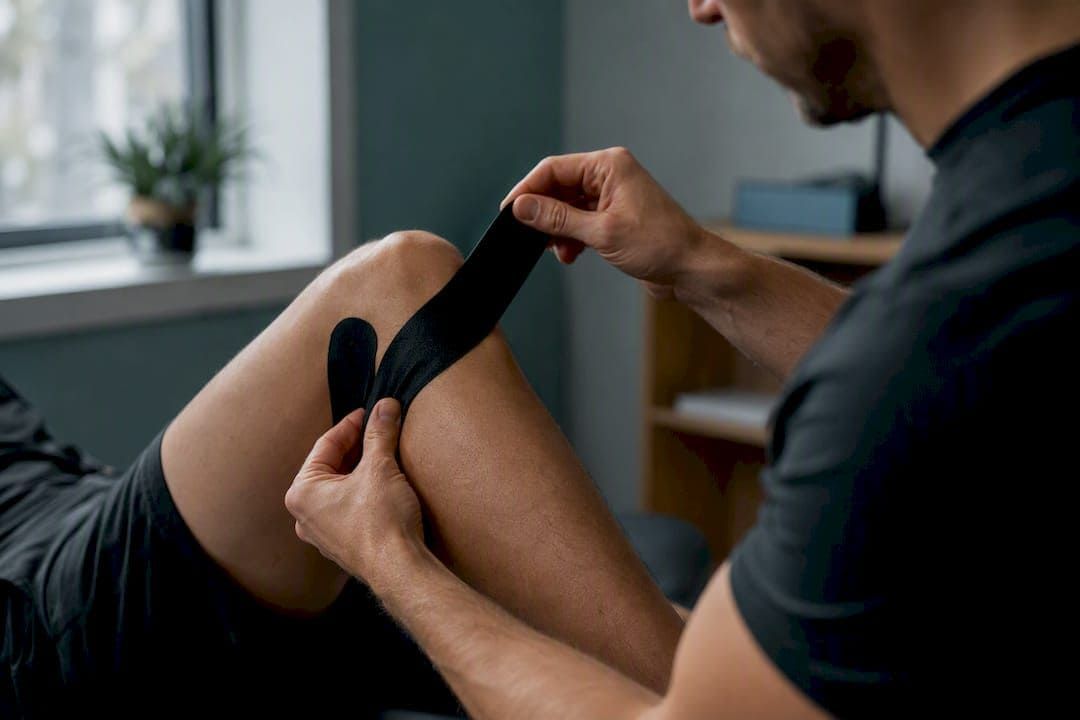
Good technique separates tape that actually helps from tape that peels off by lunch. Before you touch a roll of kinesiology tape, get the basics right: skin should be clean, dry, and free of lotion, hair should be trimmed if it's dense, and every strip's corners should be rounded with scissors so they don't catch on clothing and start an early peel.
Here are three reproducible kinesiology taping techniques for knee problems clinicians use most often.
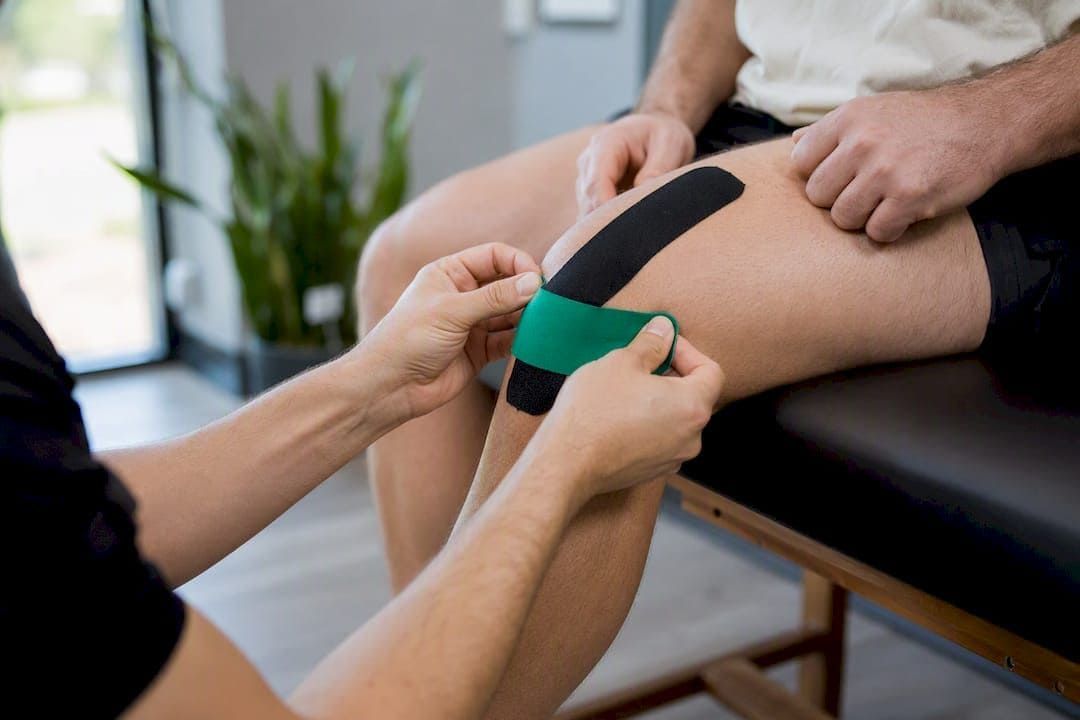
- Patellar support (for anterior knee or kneecap pain). Sit with your knee bent to roughly 60 to 90 degrees. Measure a strip from the middle of your shin bone up to just past the kneecap. Apply the base with no stretch, then lay two strips in an X pattern around the kneecap, pulling the tape to about 40 to 50% stretch as it crosses the joint. Finish with a horizontal strip directly under the kneecap at a slightly higher stretch, up to 80% at its center, to lift and stabilize the patella.
- Medial knee pain (inner knee, common with early OA or ligament strain). Anchor a strip above the inner knee with zero tension, then guide it downward across the painful area with moderate stretch, roughly 25 to 50%, before laying the tail down with no tension again. The anchors stay slack; only the section crossing the pain site should carry real tension.
- General stability wrap (for a knee that feels loose or fatigued during activity). Anchor one strip above the joint and one below it, both applied with minimal stretch, then connect them loosely around the sides of the knee. Keep the working stretch conservative, under 50%, since over-tightening a circumferential wrap risks restricting circulation rather than supporting the joint.
Reputable step-by-step guides for patellar, medial, and general stability taping echo this same sequence, and they're a solid visual reference if you're taping solo for the first time.
Pro Tip: Rub each strip firmly for about ten seconds right after applying it. The adhesive on kinesiology tape is heat-activated, and friction from your palm makes the difference between tape that lasts five days and tape that curls up by dinner.
If a strip starts lifting at the edges, trim the loose corner rather than trying to press it back down. If your skin itches or reddens under the tape itself, take it off. Persistent itching is your body telling you something the tape can't fix.
When Should You Avoid Kinesio Tape on Your Knee?
Skip taping over open wounds, active skin infections, or areas with a known adhesive allergy. If you have peripheral vascular disease, a history of deep vein thrombosis, or you're on certain anticoagulant medications, talk to a clinician before applying tape around the knee. These aren't hypothetical warnings. Restricting circulation in a leg with existing vascular risk is a real concern, not a rare edge case.
Watch for warning signs after application:
- Pain that increases rather than eases within the first hour.
- Numbness, tingling, or a cold sensation below the tape.
- Skin discoloration, blistering, or new swelling around the strip.
Any of those means remove the tape immediately and seek medical care if symptoms don't resolve quickly.
Kinesiology tape typically stays on for three to seven days, even through showers, since most brands use a water-resistant, breathable adhesive. To remove it without tearing skin, apply a little baby oil or soap and warm water to loosen the adhesive, then peel slowly in the direction of hair growth rather than against it. Rounding your corners and rubbing the tape well at application, as noted above, prevents most premature peeling before it starts.
Does Tape Direction and Tension Actually Matter?
Yes, though the effect is usually smaller than tape marketing suggests. Applying tape from origin to insertion, the muscle's starting point toward where it attaches, is generally described as facilitatory and thought to support muscle activation. Running it the opposite direction, insertion to origin, is considered inhibitory and used to calm an overactive muscle. Research on this is genuinely mixed: one study found that tape direction can measurably influence dynamic muscle performance like peak torque in some people, but the effect size is small and doesn't hold consistently across every subject.
Tension is the part beginners get wrong most often. Anchors, the first few inches of tape at either end, should go on with essentially zero stretch. Working sections crossing the area of pain typically use 10 to 50% stretch depending on the technique. Stretching tape beyond about 75% eliminates its natural elastic recoil, the very mechanism it relies on to influence the skin and underlying tissue.
- Overstretching the whole strip, not just the working section.
- Anchoring too close to the joint line instead of well above or below it.
- Leaving tape on far past a week, inviting skin irritation for no added benefit.
- Expecting tape alone to replace quadriceps and hip strengthening work.
Worth remembering: the meaningful long-term change comes from the exercise you do while wearing the tape, not the tape itself.

Using Kinesio Tape Alongside Rehab (and When to See a Clinician)
Tape performs best as a supporting actor, not the lead. The PFPS review cited earlier found that taping combined with exercise outperformed exercise alone in reducing pain and restoring function, and a reasonable trial period to judge whether it's working for you is about four weeks of consistent, combined effort.
- Build your exercise base. Focus on quadriceps and VMO strengthening, hip abductor and glute activation, and balance or single-leg stability drills. Essentialchirocare's guide to physical therapy exercises for pain relief covers progressions that naturally pair with taping.
- Track your progress simply. Rate your pain on a 0 to 10 scale during a specific task, like descending stairs, and note how deep you can go on a single-leg squat. Reassess weekly.
- Know your red flags. Mechanical locking, sudden swelling, a knee that gives way, pain that worsens despite conservative care, or any suspicion of a fracture or ligament tear all warrant a professional evaluation rather than more tape. Essentialchirocare's guide on when to see a chiropractor for lingering leg pain breaks down these warning signs in more detail.
How Clinicians Actually Decide When to Tape a Knee
In practice, taping earns its place when a patient's pain is high enough to block them from doing the exercises that will actually fix the underlying problem. A clinician might apply tape before a squat progression or a stair-climbing drill specifically to reduce pain enough for the patient to complete it with good form, then check whether that pain rating actually dropped.
A typical clinic workflow looks like this: assess the knee through functional tasks, apply targeted tape to support a specific movement, immediately retest that movement to see if symptoms changed, then build a supervised exercise progression over several weeks with periodic taping reassessment. Documenting outcomes, pain during stair descent, depth on a single-leg squat, gives an objective read on whether tape is pulling its weight for that particular patient rather than relying on a general impression. It's the same logic behind manual therapy techniques that pair hands-on work with active rehab rather than treating either in isolation.
Small application details, exact anchor angle, degree of knee flexion during placement, how much overlap between strips, explain a lot of the variation you see across studies. That variability is a good reason to have technique checked in person at least once, even if you plan to self-apply afterward.
When Taping Isn't Enough: What Essential ChiroCare Offers
Self-taping is a reasonable first move, but it has a ceiling. If your knee pain hasn't budged after two to four weeks of tape and consistent exercise, or if you're dealing with mechanical symptoms like catching or instability, that's your cue to get an actual assessment rather than trying a different taping pattern.
Essentialchirocare offers individualized knee evaluations that go beyond a generic taping tutorial: hands-on manual therapy, supervised rehab progressions built around your specific movement deficits, and in-clinic taping instruction so you're applying it correctly at home. Clinics across Tampa, Brandon, Sarasota, Lakeland, and Pinellas Park handle everything from sports-related knee strain to chronic osteoarthritis flare-ups. If your pain started with an accident or an athletic injury, the sports injury care team can build a recovery plan around it. For a broader evaluation of what's driving your knee pain and a plan tailored to it, visit the chiropractic care page to schedule an assessment.
This article is general information, not a substitute for advice from a qualified doctor. Consult a qualified healthcare professional about your own circumstances before acting on anything here.
Sources
- The efficacy of Kinesio taping combined with exercise therapy on patients with patellofemoral pain syndrome: A systematic review and meta-analysis
- Kinesio Taping Relieves Pain and Improves Isokinetic Not Isometric Muscle Strength in Patients with Knee Osteoarthritis—A Systematic Review and Meta-Analysis
- How to tape a knee for pain, stability, and support