
What Screening Prevents Harm: Cervical Adjustment Safety in Florida
What Screening Prevents Harm: Cervical Adjustment Safety in Florida
Cervical adjustments are reasonably safe for most healthy adults, with mild, short-lived side effects being common and serious vascular complications being rare enough that researchers still argue about whether the treatment causes them at all. The practical trade-off is straightforward: expect possible soreness or a brief headache, but ask your provider about screening and informed consent, and treat any sudden neurological symptom after a neck adjustment as a medical emergency.
TL;DR:
- Mild to moderate side effects occur in about half of patients and usually resolve within a few days, such as soreness, headaches, or fatigue.
- Serious adverse events like artery dissection or stroke are extremely rare, with incidence estimates ranging from 1 in 20,000 to 1 in 250 million procedures.
- Many case-control studies show associations between neck manipulation and dissection, but larger studies suggest no causal link due to biases like reverse causation.
- Clinicians should prioritize thorough patient history, screening for contraindications, and informed consent to minimize risks, rather than relying solely on premanipulative tests.
- Immediate emergency attention is necessary if sudden severe headache, neck pain, vision loss, or neurological deficits occur after a neck adjustment.

Table of Contents
- Quick numbers: how often side effects happen and what those numbers mean
- What high-quality reviews and RCT meta-analyses say
- Why some studies link neck manipulation to stroke and how to judge those findings
- Common side effects after cervical manipulation and what to expect
- Serious but rare risks: artery dissection and stroke, signs to know
- Who should avoid cervical adjustments and what screening looks like
- How clinicians minimize risk: technique choices, consent, and alternatives
- If you develop worrying symptoms after a neck adjustment: step-by-step actions
- Essential ChiroCare's approach to safety, screening, and patient education
- The safety conversation misses the point most people actually need
- If you want a clinic that emphasizes safety: how Essential ChiroCare helps
- Sources
- FAQ
Quick numbers: how often side effects happen and what those numbers mean
The most consistent figure in the research is that mild to moderate side effects are common. A systematic review of spinal manipulation found that roughly half of patients experience transient adverse events such as headache, muscle soreness or fatigue, and these typically clear up within a few days. That number holds up across different patient populations and treatment settings, which is part of why it gets cited so often.
Serious events are a different story. Because they are rare, estimates of how often they happen vary enormously depending on how the data was collected and who was counted.
- Case reports and clinic surveys tend to produce the highest estimates because they capture every reported incident, including ones with weak causal links.
- Large population studies, which compare treated and untreated groups over time, tend to produce much lower estimates because they filter out coincidental timing.
- Randomized controlled trials rarely detect serious events at all, since even large trials aren't sized to catch something that might occur once in tens of thousands or millions of visits.
This is why you'll see wildly different numbers in different articles. A case-report-driven estimate and a population-study estimate are answering slightly different questions, even though both get labeled "risk of stroke after chiropractic care." The honest summary is that mild effects are well documented and common, while serious effects are rare enough that no single number captures them with confidence.
What high-quality reviews and RCT meta-analyses say
The strongest evidence on side-effect frequency comes from randomized controlled trials, because they compare treated patients against a control group under controlled conditions. A 2024 systematic review and meta-analysis of randomized clinical trials looking specifically at cervical high-velocity, low-amplitude manipulation found no statistically significant difference in the rate of mild or moderate adverse events between manipulation and control groups. Every adverse event reported across the trials was mild, and the certainty of that evidence was rated moderate.
That reassuring result comes with an important caveat: none of the included trials were large enough to detect a serious adverse event even if one occurred, because serious events are too infrequent to show up in study samples of the size researchers can realistically recruit and fund.
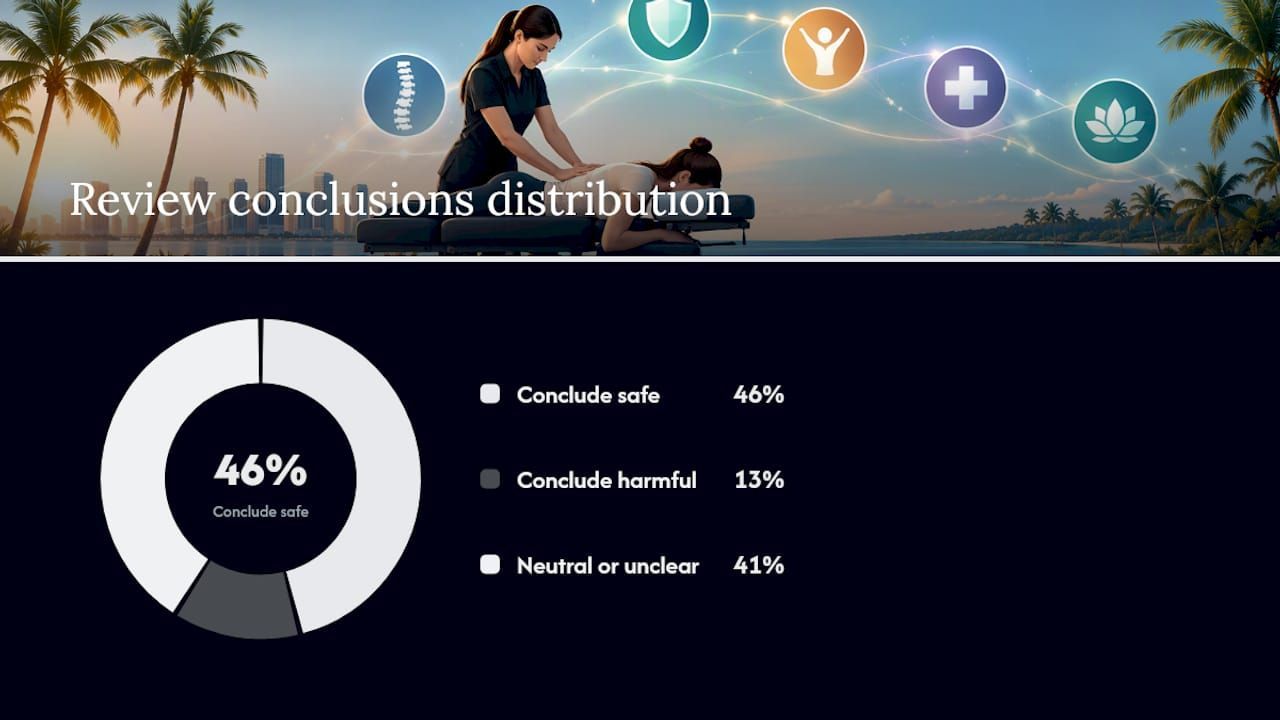
Around 46% of published reviews on spinal manipulation conclude it is safe, while 13% conclude it is harmful and the rest are neutral or unclear , according to an overview of reviews on spinal manipulation risk. That split explains a lot of the public confusion: headlines drawing from a "harmful" review and headlines drawing from a "safe" review are both technically citing peer-reviewed literature.
Two patterns emerge from that overview worth understanding:
- Reviews of higher methodological quality were more likely to conclude that spinal manipulation is safe, suggesting that some of the "harmful" conclusions trace back to weaker study designs rather than stronger evidence of harm.
- Incidence estimates for serious adverse events ranged from roughly 1 in 20,000 to 1 in 250,000,000 manipulations, a spread so wide it says more about inconsistent reporting standards than about the true risk.
The researchers behind that overview called for standardized adverse event reporting across the field, since inconsistent definitions and inconsistent follow-up periods make it difficult to compare studies directly. Until that happens, any single incidence figure should be read as a snapshot from one study design, not a settled number.
Why some studies link neck manipulation to stroke and how to judge those findings
Some case-control studies have reported a statistical association between cervical manipulation and cervical artery dissection, the condition that can lead to stroke. Those findings get attention, but they need context before you weigh them against the treatment itself.
A recurring problem in this research is protopathic bias, also called reverse-causation bias. It works like this: a dissection is already underway and starts causing neck pain or headache days before the stroke occurs. The person, feeling neck pain, visits a chiropractor for relief, and the manipulation gets blamed for a stroke that was already in motion before they walked in.
- Case-control studies comparing stroke patients to matched controls have found associations between recent cervical manipulation and dissection, but this design cannot rule out that early dissection symptoms prompted the visit.
- A scientific statement from the American Heart Association and American Stroke Association acknowledges these associations while stating plainly that causation has not been established.
- Larger retrospective analyses looking at bigger populations over longer periods have generally not found the same elevated risk, which suggests the case-control signal may be partly an artifact of study design rather than a true cause-and-effect relationship.
Reading headlines about "chiropractic and stroke" without knowing which study design produced the number is the fastest way to misjudge the actual risk.
Common side effects after cervical manipulation and what to expect
Most people who get a cervical adjustment feel something afterward, and almost all of it is minor. Roughly half of patients report some kind of transient reaction, most often in the first day or two.
- Local soreness or stiffness in the neck, similar to post-exercise muscle soreness.
- A mild, short-lived headache.
- General fatigue or tiredness for the rest of the day.
- A brief increase in pain at the treated area before it settles down.
These effects usually start within 24 to 48 hours of treatment and resolve within a few days on their own, without any specific intervention. Our guide to normal chiropractic side effects walks through what a typical recovery timeline looks like in more detail.
Pro Tip: If soreness or a headache lasts longer than about a week, or gets noticeably worse instead of better, call your clinician rather than waiting it out.
Persistent symptoms, new numbness, or anything that feels categorically different from ordinary post-treatment soreness is worth a follow-up call rather than a wait-and-see approach.
Serious but rare risks: artery dissection and stroke, signs to know
The serious event most associated with cervical manipulation in the research is cervical artery dissection, a tear in the inner lining of an artery supplying blood to the brain. When this happens in the vertebral or internal carotid artery, it can lead to a blood clot that triggers an ischemic stroke. The AHA/ASA statement notes that CeAD is an important cause of stroke in younger and middle-aged adults, separate from the manipulation question entirely, since it can also occur spontaneously or after minor trauma like a hard sneeze or a fall.
Incidence estimates for serious adverse events after spinal manipulation range from about 1 in 20,000 to 1 in 250,000,000 procedures , according to the overview of reviews cited earlier, a gap wide enough to underline that no one has pinned down a reliable number yet.
What matters practically is recognizing the warning signs early:
- Sudden, severe headache or neck pain unlike anything you've felt before.
- Double vision, slurred speech, or sudden difficulty finding words.
- Numbness or weakness on one side of the face or body.
- Sudden loss of balance or coordination.
Any of these after a neck adjustment warrants immediate emergency evaluation, not a wait-and-see call to the clinic.
Who should avoid cervical adjustments and what screening looks like
Certain conditions raise the risk profile enough that cervical manipulation should be avoided or approached with real caution. Mayo Clinic's patient guidance on chiropractic adjustment lists several categories that call for extra scrutiny before treatment.
- Severe osteoporosis or bone conditions that weaken the vertebrae.
- Spinal malignancy or a known tumor near the treatment area.
- Signs of myelopathy or progressive neurological deficits.
- Recent major cervical spine surgery.
- Known vascular disease or a prior cervical artery dissection.
- Unstable anticoagulation therapy or bleeding disorders.
The mechanical tests once used to check for vertebral artery problems before manipulation turn out to be unreliable predictors, since research on premanipulative vertebrobasilar testing found low sensitivity and specificity. That shifts the weight onto a thorough intake history: prior strokes or dissections, recent neck trauma, migraine with aura, blood pressure issues, and any new neurological symptoms should all come up before a clinician decides whether manipulation is appropriate.
How clinicians minimize risk: technique choices, consent, and alternatives
Reducing risk starts before the first adjustment. Clinicians who take safety seriously build a plan around the individual patient rather than defaulting to the same technique for everyone.
- Gentler mobilization techniques, which move the joint without a high-velocity thrust, are often chosen over rotational thrusts when a patient's history raises any concern.
- A multimodal approach combining manipulation with soft tissue work, exercise, and rehabilitation tends to spread the treatment load rather than relying on one technique alone.
- Informed consent should cover expected benefits, common side effects like soreness or headache, the rare but serious risks discussed above, and reasonable alternatives.
Pro Tip: Before your first cervical adjustment, ask directly what screening the clinician performs and whether they document your history of vascular or neurological symptoms.
Checking a provider's licensure, their experience treating neck conditions specifically, and whether they routinely document screening and consent conversations gives you a concrete way to judge quality before you commit to a treatment plan. Conservative options like targeted rehabilitation are worth discussing when manipulation feels like the wrong fit.
If you develop worrying symptoms after a neck adjustment: step-by-step actions
Knowing what to do in the hours after treatment matters more than memorizing incidence statistics.
- Call 911 or go to the nearest emergency department immediately for sudden severe headache or neck pain, sudden vision loss, slurred speech, one-sided weakness, or loss of balance.
- Stop any further treatment and tell emergency clinicians that you had a recent cervical manipulation, since that detail can prompt them to order vascular imaging sooner if a stroke is suspected.
- For less alarming but still unusual symptoms, such as persistent dizziness or a headache that won't ease, contact your treating clinician within 24 hours rather than assuming it will pass.
Acting quickly on the emergency signs is the single most important safety habit a patient can practice around this treatment.
Essential ChiroCare's approach to safety, screening, and patient education
Essential ChiroCare operates chiropractic clinics across West Central Florida, with doctors whose backgrounds include work as sports team chiropractors. That background shapes how the clinic approaches neck pain: a full history and exam come first, followed by a conversation about findings and options before any cervical adjustment is performed.
Patients are walked through informed consent as a standard part of the visit, not an afterthought, covering what to expect, common transient reactions, and when manipulation isn't the right tool for a given case. Treatment plans are built around the individual, often combining manual therapy with rehabilitation rather than relying on a single treatment. For neck pain following a car accident, the clinic's approach to whiplash and post-accident soreness follows the same screening-first logic before any hands-on care begins.
The safety conversation misses the point most people actually need
The public debate over cervical adjustment safety spends too much energy arguing over a single incidence number and not enough on the part patients can actually control—screening quality. A clinician who takes a real history, asks about prior dissections, migraine with aura, and recent trauma, and explains alternatives before touching your neck is doing more to protect you than any statistic in a review article.
The conventional advice, "ask if it's safe," is close to useless on its own. Safe compared to what, and for whom? A healthy 30 year old with no vascular history and a middle-aged patient with uncontrolled blood pressure are not facing the same risk, yet they often get the same reassurance.
What should change first is the question patients bring to the appointment. Instead of "is this safe," ask "what would rule me out, and did you check for it." That single question does more to separate a careful provider from a careless one than any published incidence figure ever will.
If you want a clinic that emphasizes safety: how Essential ChiroCare helps
If the screening and consent steps described above sound like what you'd want before anyone touches your neck, that's the standard our chiropractic care and adjustments are built around. Beyond cervical adjustments, the clinic treats whiplash, auto injury, and related neck trauma through its broader range of chiropractic services, and physical rehabilitation is available when a more conservative path makes sense for your history.
Before your first visit, bring a list of any prior neck injuries, vascular conditions, or medications affecting blood clotting, and ask directly how the clinic screens for contraindications and documents consent. Appointments can be booked online through the chiropractic care page at any of the West Central Florida locations.
This article is general information, not a substitute for advice from a qualified doctor. Consult a qualified healthcare professional about your own circumstances before acting on anything here.
Sources
- Adverse effects of spinal manipulation: a systematic review
- The risk associated with spinal manipulation: an overview of reviews
- Adverse Events After Cervical Spinal Manipulation – A Systematic Review and Meta-Analysis of Randomized Clinical Trials
- Cervical arterial dissections and association with cervical manipulative therapy: scientific statement (AHA/ASA)
FAQ
How often do neck adjustments go wrong?
Mild reactions like soreness, headache, or fatigue happen in roughly half of patients and usually resolve within a few days. Serious complications are rare, though published estimates vary widely depending on study design, as shown in an overview of spinal manipulation reviews.
How common is a stroke after neck manipulation?
Stroke after neck manipulation is rare, and researchers have not established that manipulation causes it rather than coinciding with a dissection already in progress. The AHA/ASA scientific statement notes associations in some case-control studies but stops short of confirming causation.
What is the likelihood of being paralyzed by a chiropractor?
There is no reliable, agreed-upon figure for this specific outcome in the research reviewed here. What's documented is that serious vascular events like artery dissection are rare, with incidence estimates in published overviews ranging enormously depending on the data source, and paralysis would be an extremely rare downstream consequence of the rarest of those events.
Is it possible for a chiropractor to injure my neck?
Mild, transient soreness or stiffness after a cervical adjustment is common and expected, and this is different from a true injury. Serious injury is uncommon, and clinicians reduce that risk through screening for contraindications like vascular disease or recent trauma, as outlined in Mayo Clinic's patient guidance.
Recommended