
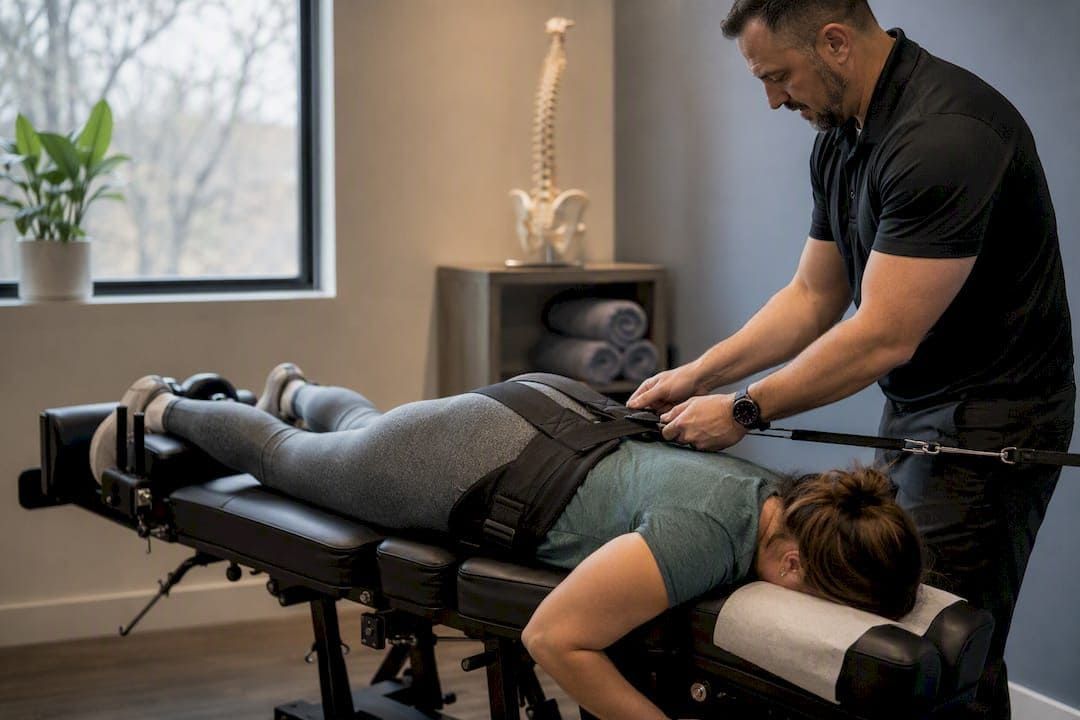


Spinal Decompression Side Effects: What's Normal, What's Not

Essential ChiroCare Blogger • August 18, 2026

Spinal Decompression Side Effects: What's Normal, What's Not

Most people who try non-surgical spinal decompression feel nothing worse than mild soreness that fades within a day or two, and serious complications are rare when a clinician screens candidates properly first. The Cleveland Clinic lists temporary soreness and a short-lived increase in pain as the typical reactions, not the exception. Most soreness resolves within 24 to 48 hours, according to patient-facing guidance from Medical Center Plus.

After a session, here's what to actually do:

  • Apply ice to the treated area for 15 to 20 minutes if soreness shows up
  • Keep moving with light walking rather than lying flat all day
  • Take an over-the-counter pain reliever if needed and approved by your provider
  • Call your clinician if soreness lasts beyond 48 to 72 hours or worsens with each visit
  • Skip the next session and seek same-day evaluation if you notice new numbness or weakness

Stop and get urgent care if you experience progressive leg weakness, numbness in the groin or inner thighs (saddle anesthesia), or sudden loss of bladder or bowel control. These are not typical side effects. They're signs of possible cauda equina involvement and need same-day medical attention, not a wait-and-see approach.

spinal decompression side effects

Key Takeaways

Spinal decompression side effects are typically mild and short-lived, while serious complications remain rare and almost always linked to inadequate candidate screening.

Point Details
Mild soreness is normal Expect temporary soreness or fatigue for 24 to 48 hours after early sessions.
Serious complications are rare Adverse events like worsening herniation or nerve irritation appear in isolated case reports, not routine outcomes.
Screening determines risk Conditions like fractures, severe osteoporosis, or spinal implants require clearance before treatment.
Red flags need urgent care Progressive weakness, saddle anesthesia, or bladder/bowel changes mean stop treatment and seek help same day.
Evidence quality is limited Few large randomized trials exist, so long-term safety data remains incomplete.
Essential ChiroCare screens first The clinic pairs pre-treatment imaging review and credentialed staff with an integrated rehab plan.

Table of Contents

What Are the Common Spinal Decompression Side Effects?

The side effects of spinal therapy that show up most often are mild and mechanical: your spine and surrounding muscles are being stretched and repositioned, and tissue that hasn't moved that way in years tends to complain a little. Healthline's overview of decompression therapy lists temporary soreness, muscle spasm, and fatigue as the most commonly reported reactions, alongside occasional short-term increases in pain before things improve.

Here's the typical pattern:

  • During or right after the session: a stretching sensation, sometimes mild discomfort, rarely anything sharp
  • First 24 to 48 hours: soreness similar to a new workout, sometimes a dull ache along the treated segment
  • First week: soreness tapers with each session as your body adapts
  • Weeks two through six: most patients report the soreness has faded and functional improvement starts to accumulate

Mild soreness that fades within a short period is normal. Soreness that intensifies with each visit, or that spreads to a new area, is a signal for your provider to reassess force, position, or candidacy.

Pro Tip: Track your soreness on a simple 1 to 10 scale after each session. A pattern that trends downward over your first week is reassuring; a flat or rising trend is worth flagging at your very next visit rather than waiting it out.

Are There Serious Complications From Decompression Therapy?

Serious decompression therapy risks exist, but they're uncommon and almost always tied to poor candidate selection rather than the treatment itself. A critical literature review of non-surgical spinal decompression documents isolated case reports of adverse events, language that reflects how infrequently these occur, not how mild they are.

Reported complications include:

  • Worsening of an existing disc herniation
  • New or intensified nerve irritation
  • Fracture in patients with undiagnosed severe bone disease
  • Increased neurological symptoms in poorly screened patients

Isolated reports, not a pattern of routine harm, is how the clinical literature describes these events. That distinction only holds true when screening happens before treatment starts.

If you notice progressive weakness, spreading numbness, or any change in bladder or bowel function during a course of care, stop treatment and get evaluated the same day.

Who Should Avoid Spinal Decompression or Take Extra Precautions?

Contraindications exist because certain spinal conditions make traction forces genuinely risky rather than just uncomfortable. Conditions that typically rule out decompression, or require a specialist's clearance first, include pregnancy, severe osteoporosis, spinal fractures, prior spinal fusion or hardware, active infection, unstable vertebrae, and significant neurologic deficits, a list echoed across clinic safety guidance on decompression contraindications.

Patients on anticoagulants or with conditions affecting bone density should raise that with both their prescriber and their chiropractor before starting. Similar caution applies to other mechanical therapies: vibration plate contraindications cover overlapping risk factors worth knowing if you're weighing multiple conservative options.

A responsible provider screens with a health history, imaging review, and a neurologic exam before the first session.

Pro Tip: Ask your clinician three things before you start: What did my imaging show that makes me a good candidate? What force and position will you use, and why? What symptom would make you stop my treatment mid-course?

What Happens After One Session, and Over a Full Course?

  1. During the session: a gentle stretching sensation over 15 to 20 minutes, per typical protocols described in comparisons of decompression and surgery
  2. 0 to 48 hours: mild soreness is common and expected
  3. First week: soreness eases; some patients notice early symptom relief
  4. Weeks four to six: most measurable benefit accumulates across a full course

If pain worsens instead of easing by your second or third visit, that's the moment to ask your provider to adjust force, angle, or frequency, not push through it.

side effects of spinal decompression

How Do Clinicians Reduce the Risk of Complications?

Screening is the single biggest safety factor. Before treatment, a qualified provider reviews your history, checks imaging, runs a neurologic exam, and asks about prior spinal surgery or bone health, a process outlined in guidance on decompression risk factors.

From there, they personalize the approach:

  • Adjusting traction force, angle, and session duration to your condition
  • Combining decompression with rehab exercises rather than using it alone
  • Rechecking symptoms at each visit and modifying the plan if soreness escalates
  • Documenting informed consent, including risks, alternatives, and expected timeline

Pro Tip: A provider who can't explain why they chose a specific force setting for your spine, or won't walk you through your imaging, hasn't done the homework this treatment requires.

How Strong Is the Evidence on Spinal Decompression Safety?

The research base here is thinner than most patients assume. A PMC literature review of traction and spinal decompression found that many studies are small, methodologically weak, and short on high-quality randomized controlled trials for modern decompression units specifically.

That gap matters for how you read safety claims:

  • Few large randomized trials exist; much of the evidence comes from case series and small studies
  • Some published research carries industry or marketing influence, a concern the ResearchGate critical review raises directly
  • Device types, patient positioning, and protocols vary widely across studies, making direct comparisons difficult
  • Follow-up periods in many studies are short, so long-term safety data stays limited

The practical takeaway: decompression appears reasonably safe for well-screened candidates, but "reasonably safe" isn't the same as "extensively proven." Treat bold guarantees in marketing with skepticism until the underlying research catches up.

What Should a Safe Clinic's Decompression Program Look Like?

A trustworthy clinic makes its safety process visible, not just its results. Look for credentialed clinicians, a pre-treatment imaging or history review, documented informed consent, supervised sessions rather than unattended equipment, and a rehab plan that integrates decompression with exercise or manual therapy.

Before booking, ask who actually adjusts the device settings, what their emergency protocol looks like, and how they screen for contraindications.

A clinic that can answer specific questions about screening and force settings without hesitation is showing you its safety process, not just its marketing copy.

Multiple locations, transparent scheduling, and educational resources beyond a sales page are reasonable signals a practice, like Essential ChiroCare's spinal decompression guide, takes the screening step seriously.

A balanced take on benefit versus risk

Patients often arrive worried this treatment is riskier than it is, or convinced it's risk-free because a website says so. Neither is accurate. Decompression is one tool in a broader conservative care plan, and its safety depends almost entirely on whether someone screened you properly before turning on the machine. Ask questions. Expect answers.

What to Expect From Essential ChiroCare's Decompression Program

Essential ChiroCare screens every decompression candidate with a history review, imaging check, and neurologic exam before treatment starts, then pairs sessions with a rehab plan built around your specific findings, not a generic protocol. Credentialed clinicians adjust force and positioning based on what your spine actually shows, not a one-size template.

If you're weighing decompression against other options, start with the clinic's guide to spinal decompression to see how candidacy and safety screening work in practice, or explore chiropractic care services to schedule a consultation. A clinician can tell you within one visit whether decompression fits your spine or whether a different conservative approach makes more sense. Book a consultation and get a direct answer instead of guessing from search results.

Frequently Asked Questions

  • Is spinal decompression safe for most people?

    Yes, for properly screened candidates. Mild soreness is common, but serious complications are uncommon when a provider checks imaging and history first.

  • How long do spinal decompression side effects usually last?

    Most soreness resolves within 24 to 48 hours. Soreness lasting longer or worsening with each session should prompt a check-in with your provider.

  • What are the biggest spinal decompression risks?

    The main decompression therapy risks involve poor candidate selection, meaning conditions like fractures, severe osteoporosis, or spinal instability that raise the chance of harm if untreated screening lets someone proceed anyway.

  • How does spinal decompression compare to surgery on safety?

    Decompression is non-invasive and generally lower-risk than surgery, but it isn't a universal substitute. Surgery becomes necessary when red-flag symptoms like progressive weakness or loss of bladder control appear.

This article is general information, not a substitute for advice from a qualified doctor. Consult a qualified healthcare professional about your own circumstances before acting on anything here.

Sources

Recommended

Chiropractor treating back pain
By Essential ChiroCare Blogger September 11, 2026
Learn about common chiropractic side effects, including normal soreness and rare complications. Stay informed for safer treatments.

ankle sprain chiropractic care
By Essential ChiroCare Blogger September 10, 2026
Discover how ankle sprain chiropractic care speeds up recovery with targeted manipulation and rehab, easing pain and enhancing mobility.

chiropractic trigger point therapy
By Essential ChiroCare Blogger September 9, 2026
Discover how chiropractic trigger point therapy can provide immediate pain relief and explore techniques for lasting benefits through repeated sessions.

does insurance cover chiropractic care
By Essential ChiroCare Blogger September 8, 2026
Discover how insurance covers chiropractic care in the U.S. Learn about plans, limits, and what to expect before your visit.

pediatric chiropractic care Tampa
By Essential ChiroCare Blogger September 7, 2026
Learn causes of back pain in kids and when a pediatric chiropractor in Tampa can help with gentle, holistic care for comfort and mobility.

knee pain treatment Tampa
By Essential ChiroCare Blogger September 6, 2026
Learn common signs your weekend pick-up games are stressing your knees and when to see a knee pain chiropractor in Tampa for relief and recovery advice.

Medicare chiropractic coverage
By Essential ChiroCare Blogger September 5, 2026
Discover what Medicare chiropractic coverage includes. Learn about the specifics of spinal manipulation benefits and costs.
chiropractic adjustment frequency
By Essential ChiroCare Blogger September 4, 2026
Discover how chiropractic adjustment frequency varies by phase. Learn what to expect and how it promotes healing and overall wellness.

symptoms of poor mobility
By Essential ChiroCare Blogger September 3, 2026
Identify early symptoms of poor mobility and learn effective strategies to enhance your movement and independence. Act now for better health!

ergonomic setup checklist
By Essential ChiroCare Blogger September 2, 2026
Transform your workspace with this quick 10-minute ergonomic setup checklist to alleviate neck, back, and wrist pain effectively.
Show More