


Quick Triage for Text Neck Symptoms and 2–6 Week Self Care Plan

Essential ChiroCare Blogger • October 20, 2026

Quick Triage for Text Neck Symptoms and 2–6 Week Self Care Plan

Text neck symptoms usually show up as aching or sharp neck pain, tight shoulders, stiffness, and headaches that build after long stretches of looking down at a phone or laptop. Most of this is muscular, not structural, and it tends to ease once you change posture and take breaks. But arm tingling, numbness, or weakness are different signals that deserve a closer look, which the timeline further down covers in detail.

TL;DR:

  • Symptoms involving tingling, numbness, or weakness in the arm or hand indicate nerve involvement and require prompt medical evaluation.
  • A forward head tilt of around 60 degrees significantly increases strain on neck muscles, especially the upper trapezius, levator scapulae, and suboccipital muscles.
  • Ergonomic adjustments such as elevating screens to eye level and taking movement breaks every 20 minutes are key to preventing and alleviating text neck symptoms.
  • Persistent or worsening pain, especially with neurological signs, should prompt a consultation with a healthcare professional for targeted therapy or diagnostic imaging.
  • Corrective exercises focusing on neck mobility and scapular strengthening, combined with manual therapy, are effective for long-term relief, especially when done consistently over weeks.
text neck treatment

Table of Contents

Common Text Neck Symptoms and Warning Signs to Watch

Forward head posture symptoms tend to follow a pattern. The neck and shoulders take the brunt of it first, but the effects often spread to the head and jaw before people connect the dots back to their phone habit.

The Yale Medicine description of tech neck lines up with what most people actually report: aching or sharp neck pain, stiffness, shoulder tightness, headaches, and a noticeably smaller range of motion when turning the head side to side.

Common symptoms of text neck include:

  • Dull or sharp pain along the back or sides of the neck
  • Stiffness that makes turning your head feel restricted
  • Tight, sore shoulders, sometimes described as a knotted feeling
  • Tension headaches that start at the base of the skull
  • Jaw tightness or soreness, often mistaken for a dental issue
  • General muscle fatigue in the upper back by the end of the day

Pro Tip: Symptoms that get noticeably worse after long screen sessions and ease up once you move around are a strong clue the problem is mechanical, not something more serious.

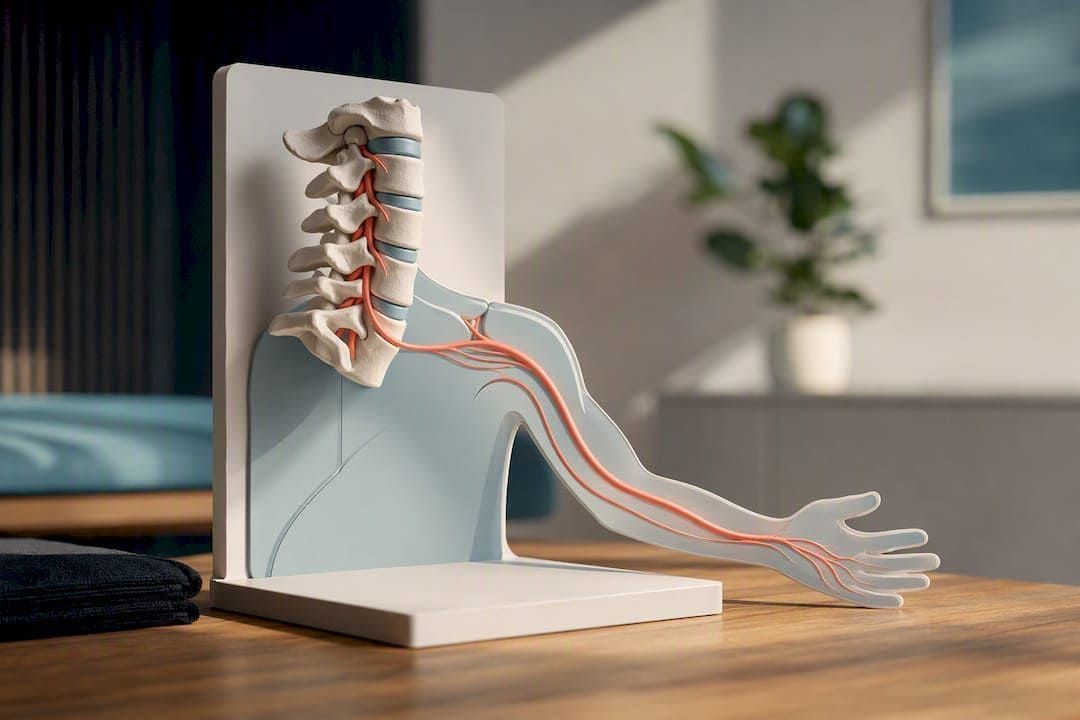
A smaller group of symptoms points somewhere more concerning. Mayo Clinic Health System notes that irritation of nerves in the neck can cause pain, tingling, numbness, or weakness that travels down into the arm or hand. That's a different problem than a stiff neck. When a nerve root gets compressed or irritated, it doesn't just ache locally, it sends signals down the whole nerve pathway, which is why people sometimes feel numbness in their fingers and have no idea it started at their neck.

Timing matters too. Neck pain from phone use typically builds gradually across a workday or a long scrolling session, then softens somewhat overnight or after you get up and move. If the pattern reverses, meaning pain is constant regardless of activity or getting worse week over week, that shift itself is worth paying attention to.

Why Looking Down at a Screen Wrecks Your Neck

The mechanics behind text neck posture issues come down to one number: the craniovertebral angle, which is basically the tilt of your head relative to your neck and shoulders. A smaller angle means more forward head tilt, and the physics get ugly fast.

Your head weighs roughly five kilograms in a neutral position. Tilting it forward increases the effective load on your neck muscles substantially. At about a 60-degree tilt, typical when texting with chin down, the load on your neck muscles is significantly higher, adding considerable strain. Your neck muscles were never built to hold that kind of weight for hours a day, so they fatigue, tighten, and start sending pain signals.

The muscles doing the suffering are mostly:

  • The upper trapezius and levator scapulae, which get stuck in a constant contracted state trying to hold your head up
  • The suboccipital muscles at the base of the skull, a common source of tension headaches
  • The deep neck flexors, which weaken from disuse while the bigger muscles overcompensate

Here's the part people get wrong: a stiff, sore neck from a weekend of scrolling is not the same as permanent damage. The PMC review on text neck syndrome treats forward head posture as a predisposing factor tied to disability and pain, not proof of structural breakdown. Yale Medicine's own framing backs this up: most of what people feel is muscular and soft tissue related, and degenerative changes are a longer-term risk from years of unaddressed posture, not something that happens after a bad week. Posture habits accumulated over years are what shift risk, not one long text thread. That's exactly why posture matters for long-term health well beyond how your neck feels today.

When Text Neck Needs a Doctor, Not Just a Stretch

Most text neck pain is safe to manage yourself, at least at first. But a few signs mean you shouldn't wait, and a smaller subset means you shouldn't even finish reading this article before calling for help.

Call 9-1-1 immediately if you notice any of these, since the CDC's stroke warning signs list them as emergencies, not something to sleep on:

  • Sudden weakness or numbness on one side of the face, arm, or leg
  • Facial drooping, especially if it's new and one-sided
  • Slurred speech or sudden trouble understanding others
  • A sudden, severe headache with no known cause

Separately, contact a clinician sooner rather than later for neurologic signs coming from the neck itself, even if they don't look like an emergency: progressive arm weakness, numbness that's spreading rather than staying put, or new clumsiness in your hands. These suggest nerve involvement that benefits from evaluation before it worsens.

For everything else, a practical rule of thumb works well. Give conservative measures, meaning posture changes, breaks, and gentle exercise, about two to six weeks before looping in a primary care provider or physical therapist if you're not seeing improvement. Reach out sooner if pain is disrupting your sleep or making basic daily tasks harder, since waiting rarely helps once it's at that point.

How To Relieve Text Neck With Ergonomics and Breaks

Fixing the setup you sit in everyday does more for text neck relief than any single stretch. OSHA's workstation guidance lays out the basics clearly, and most of it applies just as well to a phone as it does to a desktop monitor.

  1. Bring screens up to eye level. The top of your monitor should sit at or slightly below eye level, roughly an arm's length away. For phones, that means lifting the device rather than dropping your chin.
  2. Use a stand or prop for tablets and laptops. If you raise a laptop screen without adjusting the keyboard too, you just trade neck strain for shoulder strain. OSHA recommends pairing a raised screen with an external keyboard so your arms stay in a natural position.
  3. Hold your phone with two hands and bring it up, not your head down. Texting one handed while your other arm holds a bag or a coffee is a fast route to a tilted head.
  4. Take short movement breaks. OSHA's own examples suggest brief posture shifts every 20 minutes or so, plus roughly 5 minutes away from the screen each hour.
  5. Change position often rather than chasing one perfect posture. Staying rigidly upright for three hours straight causes its own fatigue. Moving between a few reasonably good positions beats holding one ideal one too long.

For symptom relief in the moment, heat or ice both work depending on preference, and over-the-counter pain relievers can help short term. Gentle range of motion, like slow neck rolls or shoulder shrugs, keeps blood moving through tight muscles better than sitting still does.

Pro Tip: Set a recurring alarm for movement breaks instead of relying on willpower. Text neck symptoms build slowly enough that you often don't notice you've been frozen in one position for 90 minutes until your neck is already locked up.

If you want a fuller walkthrough of desk setup adjustments, this ergonomic setup checklist covers the details beyond screen height and breaks.

how to relieve text neck

Exercises That Actually Help Text Neck Pain

Ergonomics reduce the load going into your neck. Exercise builds the capacity to handle whatever load remains, and both matter for lasting text neck treatment.

  1. Start with gentle mobility work. Slow chin tucks, neck rotations, and shoulder rolls loosen tight tissue without stressing anything. Do these daily, even on days you feel fine.
  2. Add deep neck flexor activation once mobility feels easier. These are the small muscles at the front of your neck that weaken from years of forward head posture. Simple chin tuck holds, done for a few seconds at a time, retrain them to do their job again.
  3. Bring in scapular stabilizer work. Rows, wall slides, and shoulder blade squeezes strengthen the muscles that hold your shoulders back and down, which takes pressure off the neck muscles compensating for weak posture.
  4. Progress gradually over several weeks. A reasonable pattern is daily mobility work, strength work three times a week, and advancing resistance or reps only as symptoms allow, not on a fixed schedule.

A systematic review of forward head posture treatment programs found that corrective exercise combined with manual therapy improved both pain and disability more consistently than exercise alone. Manual therapy isn't a replacement for the exercise work, it's an adjunct that helps loosen restricted tissue so the exercises land better.

Pro Tip: If you're not seeing any improvement after a few weeks of consistent home exercise, that's the signal to move from self-directed work to supervised physical therapy rather than pushing harder on your own. A structured physical rehab program can identify which specific muscles are underperforming instead of guessing.

For a broader menu of relief options beyond these four movements, this neck pain management list rounds out ten strategies worth trying.

What a Clinician Does for Persistent Text Neck

If home exercise and ergonomic fixes aren't cutting it after several weeks, a clinical evaluation usually follows a predictable path. A provider takes a history and does a physical exam first, checking range of motion, strength, and reflexes before deciding on anything more involved.

Imaging like X-rays or an MRI generally isn't the first step. It gets ordered when red flags appear, meaning progressive weakness, numbness that isn't improving, or symptoms that don't respond to a reasonable trial of conservative care.

From there, treatment commonly includes:

  • Targeted physical therapy focused on the deep neck flexors and scapular muscles
  • Manual or chiropractic therapy to address restricted joint movement and muscle tightness
  • A supervised, progressive exercise program rather than a generic handout
  • Referral to pain management in the rare cases where conservative care isn't enough

Most people improve with conservative treatment. Chronic cases or ones involving nerve symptoms need closer follow-up, sometimes over a period of months rather than weeks. When you book an evaluation, it's worth asking what specific muscle groups are weak or tight, how progress will be measured, and what your realistic timeline looks like based on how long symptoms have been present.

A Clinical Perspective on Fixing Text Neck for Good

The mistake I see repeated constantly is treating text neck like a stretching problem instead of a habit problem. Stretches feel productive, but they don't undo eight hours of chin-down scrolling. Conservative, evidence-based care, meaning posture correction paired with real strengthening work, consistently outperforms quick fixes. Some chiropractic and physical rehab approaches focus on addressing the mechanical root of text neck problems, not just the symptom of the week. If your neck pain has stuck around longer than a few weeks despite trying the basics, it's worth getting evaluated before the habit gets more baked in.

Get Your Neck Evaluated at Essential ChiroCare

Essential ChiroCare treats text neck the way it should be treated: as a mechanical problem with a mechanical fix, not another prescription for rest and ibuprofen. Where a generic stretching app gives you the same five moves regardless of your actual posture pattern, our clinics build a plan around what your neck exam actually shows.

Your first visit includes a real evaluation of your posture, range of motion, and muscle imbalances, not a five-minute glance. From there, you get an individualized plan that might combine chiropractic care with physical rehab or, for more entrenched cases, spinal decompression to relieve pressure on compressed structures. Some clinics in West Central Florida accept most insurance plans and can assist patients with coverage prior to visits. If text neck has been dragging on longer than a few weeks, schedule an appointment online and get a plan built around your specific posture pattern instead of a generic printout.

This article is general information, not a substitute for advice from a qualified doctor. Consult a qualified healthcare professional about your own circumstances before acting on anything here.

Sources

FAQ

  • How long does it take for text neck to go away?

    Mild cases often improve within a few days to a couple weeks once you reduce screen strain and add gentle movement. More established cases, especially with muscle weakness built up over months, can take several weeks of consistent exercise and ergonomic changes to fully resolve.

  • What are the early signs of tech neck?

    Early symptoms of text neck usually include mild neck stiffness, tightness across the shoulders, and a tension headache that starts at the base of the skull after long screen sessions. These symptoms typically ease with movement early on, which is a useful clue that the cause is mechanical rather than something more serious.

  • Is it possible to fix text neck?

    Yes. Most text neck symptoms are muscular and respond well to a combination of posture correction, ergonomic adjustments, and targeted exercises like chin tucks and scapular strengthening, according to Yale Medicine. Persistent or nerve-related cases benefit from professional evaluation, and options like chiropractic care can help address cases that don't resolve with self-care alone.

  • Where is text neck pain located?

    Text neck pain is centered in the back and sides of the neck, often spreading into the shoulders and up into the base of the skull as tension headaches. In cases involving nerve irritation, pain, tingling, or numbness can radiate down into the arm or hand.

Recommended

exercises for spinal stenosis
By Essential ChiroCare Blogger • October 19, 2026
Follow an evidence informed, clinician friendly 4 week routine of flexion mobility, core, balance, and low impact cardio to ease leg pain and increase...

chiropractic care in Tampa
By Essential ChiroCare Blogger • October 18, 2026
Learn how a chiropractor in Tampa can help ease post-hurricane cleanup strain, support mobility, and promote a safer recovery after demanding physical work.

car accident chiropractor in Tampa
By Essential ChiroCare Blogger • October 17, 2026
Learn when emergency care is needed after a crash and how a car accident chiropractor in Tampa can support recovery, pain relief, and mobility.

degenerative disc disease exercises
By Essential ChiroCare Blogger • October 16, 2026
Begin a safety first home program for degenerative disc disease: six low-risk exercises, McKenzie extension cues to watch for centralization, and clear...

postpartum back pain exercises
By Essential ChiroCare Blogger • October 15, 2026
Breath first, diastasis safe exercises and simple daily ergonomics to ease postpartum low back pain. Start with 10 minutes of gentle core and glute work.

how much does spinal decompression cost
By Essential ChiroCare Blogger • October 14, 2026
Typical U.S. prices run $30–$250 per session or $500–$7,500 per course. See insurer realities, clinic transparency tips, and four practical ways to lower...

chin tuck exercise benefits
By Essential ChiroCare Blogger • October 13, 2026
Clinician backed chin tuck primer: precise step-by-step technique, randomized trial evidence they outperformed stretching, and when to seek clinical care....

neck pain after sleeping
By Essential ChiroCare Blogger • October 12, 2026
Fix morning neck pain tonight with three simple changes: swap the pillow, change sleep position, and do gentle morning movements. Learn red flags and when...

back pain chiropractor Tampa
By Essential ChiroCare Blogger • October 11, 2026
Lingering back pain can disrupt work and sleep. Learn when self-care may help and when to see a chiropractor in Tampa for personalized relief.

personalized chiropractic care Tampa
By Essential ChiroCare Blogger • October 10, 2026
Learn what sets the best chiropractor in Tampa apart, from personalized care and injury recovery to rehabilitation and wellness-focused treatment plans.
Show More