

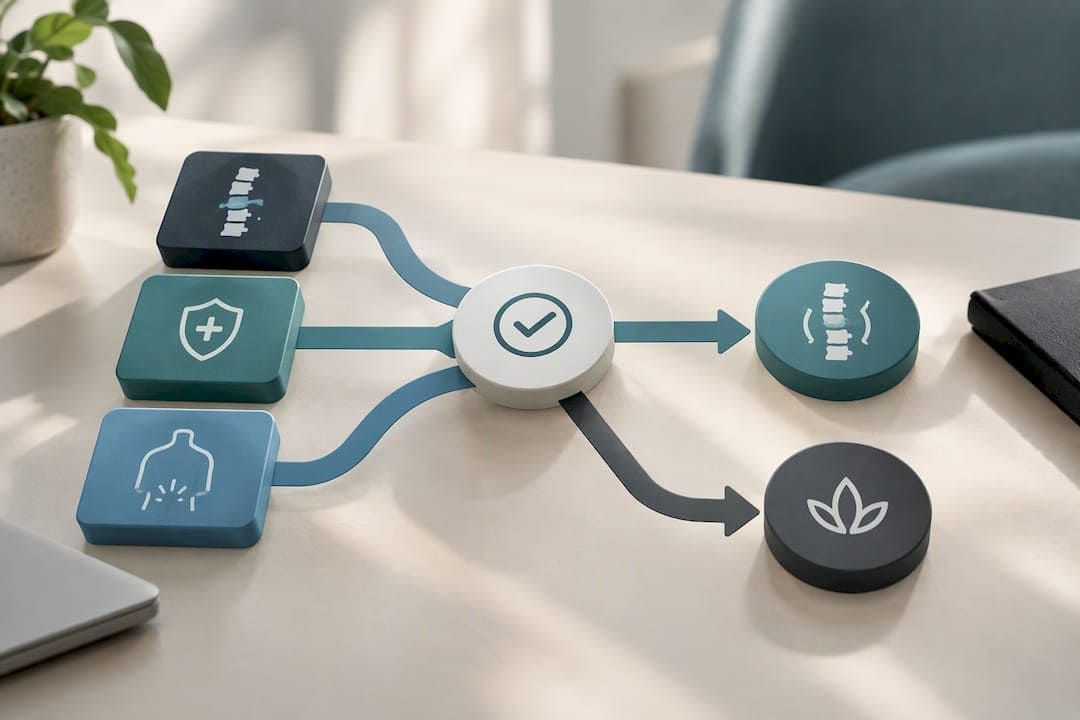

Patients: 3–6 Sessions, 4–8 Weeks for Spinal Decompression Results
Many patients notice early relief from spinal decompression within the first three to six sessions, but changes that hold up in pain and disability scores typically take a full four to eight-week program to appear. Study results vary widely: some retrospective reviews report large drops in reported pain, while systematic reviews rate the overall evidence as limited. Decompression tends to work best as one piece of a broader rehabilitation plan, not a stand-alone fix.
TL;DR:
- Most patients see early pain relief within three to six sessions, but significant and lasting improvements typically require a four to eight-week program.
- Reassessment after six to eight sessions helps determine if continuing the same protocol is effective, as lack of progress suggests adjusting treatment.
- The strongest evidence supports decompression when combined with physical therapy and for patients with recent, MRI-confirmed disc issues, without spinal stenosis or instability.
- The typical decompression session involves harness fitting, 15 to 25 minutes of traction cycles, and outcome tracking with pain and disability measures.
- Long-term relief depends heavily on ongoing activity, exercise, and lifestyle changes, making decompression part of a broader maintenance plan rather than an isolated fix.

Table of Contents
- What to expect week by week during treatment
- What the research actually shows
- Who tends to benefit and who should skip it
- Inside a typical session and how progress gets tracked
- Does the relief last, and how do you keep it
- How a full treatment plan builds on decompression
- When decompression makes sense and when it does not
- Get evaluated for spinal decompression at Essential ChiroCare
- Sources
- FAQ
What to expect week by week during treatment
Most clinics run sessions of 30 to 45 minutes, often scheduling 20 to 28 visits across four to eight weeks, a pattern echoed in patient-facing summaries from WebMD. What changes, and when, tends to follow a rough sequence:
- Sessions one through six : sharp or radiating leg pain often eases first, along with small gains in sitting or walking tolerance.
- Weeks two through four : stiffness after activity decreases, and patients usually notice they can hold positions longer without flare-ups.
- Weeks four through eight : measurable shifts on pain and disability scores appear, along with better endurance for daily tasks.
- After the full course : clinicians reassess against the starting baseline to decide whether to continue, taper, or stop.
A useful checkpoint is a reassessment after six to eight sessions. If there is no meaningful change in pain or function by that point, continuing the identical protocol rarely produces a different outcome, and it is worth adjusting the plan or exploring other conservative care.
What the research actually shows
The evidence on spinal decompression is mixed, and the quality varies a lot depending on the study design. A few patterns stand out:
- Large retrospective clinic reviews often report high rates of patient-reported improvement, but these designs are prone to selection bias and rarely isolate decompression from other treatments given at the same time.
- Randomized trials comparing decompression to other conservative therapies show smaller, more modest effects, and gains do not always hold at follow-up.
- Systematic reviews of traction-based therapies, which include motorized decompression, generally describe the evidence as low-quality and find little consistent long-term advantage over sham or standard traction, per a 2019 Cochrane-linked review.
- Decompression appears to add the most value when paired with structured physical therapy rather than used alone.
One retrospective chart review of 267 patients found a 90.5% patient-reported reduction in pain after at least 20 sessions over six to eight weeks , with average pain scores dropping from 6.9 to 2.5 on a 10-point scale, according to a 2025 clinical chart review. That is a striking figure, but it comes from a single-clinic retrospective series rather than a controlled trial, so it should be read as a best-case snapshot rather than a typical outcome. An earlier randomized trial comparing decompression to TENS found 68.4% of the treatment group met success criteria by the end of treatment, but that dropped to 36.8% still improved at six months, a reminder that early gains do not always last without reinforcement.
Who tends to benefit and who should skip it
Spinal decompression is generally considered for people with imaging-confirmed disc bulges or herniations causing radicular (nerve-related) pain, some cases of degenerative disc disease, and select radiculopathy presentations. Outcomes tend to be better in specific circumstances:
- Symptoms present for a shorter period rather than pain that has persisted for years without change.
- A discrete disc finding on MRI rather than diffuse, multi-level degeneration.
- No severe central spinal stenosis or spinal instability, which can respond poorly to traction-based forces.
Certain conditions rule decompression out entirely, including pregnancy, spinal fractures, active infection, severe osteoporosis, and some surgical implants. A qualified clinician should screen imaging and medical history before starting.
Pro Tip: Bring recent imaging reports (MRI or X-ray) to your first evaluation. It speeds up the decision on whether decompression fits your case, and it prevents wasted sessions if you are not a good candidate.
Inside a typical session and how progress gets tracked
A decompression session usually starts with a harness fitted around the pelvis and torso while the patient lies on a motorized table. The machine then applies gentle traction cycles, alternating tension and release, sometimes paired with heat or TENS before or after the main protocol.
- Setup and positioning : five to ten minutes to fit the harness and position the spine correctly.
- Traction cycles : 15 to 25 minutes of alternating pull and release, adjusted to the patient's comfort and diagnosis.
- Adjunct care : heat, electrical stimulation, or manual therapy layered in before or after traction.
- Outcome tracking : clinicians log changes on the Visual Analog Scale (VAS) and Oswestry Disability Index (ODI), plus range-of-motion and walking tolerance, to decide whether to continue the plan as written.
Programs in research settings and in clinics commonly run 12 to 28 sessions over four to eight weeks, with adjustments made along the way based on those same measures rather than a fixed script.
Does the relief last, and how do you keep it
Durability depends heavily on what happens after the last session. A 2022 randomized trial found that adding non-surgical decompression to routine physical therapy produced better pain, range-of-motion, and disability outcomes at four weeks than physical therapy alone, suggesting the combination holds up better than decompression by itself. Separately, some image-guided procedural approaches for spinal stenosis have shown improvement sustained out to three years in a randomized trial, though that is a different intervention from motorized non-surgical decompression and applies to a narrower patient group.
Results tend to fade for a few predictable reasons:
- The underlying disc or joint degeneration continues to progress regardless of short-term symptom relief.
- Patients stop the exercise and rehab work once pain eases, and old movement patterns return.
- Weight, posture, and activity habits that contributed to the original problem go unchanged.
Pro Tip: Treat decompression as the start of a maintenance plan, not the end of one. Periodic evaluation, a home exercise routine, and occasional booster sessions do more for lasting relief than the initial course alone.

How a full treatment plan builds on decompression
At Essential ChiroCare, spinal decompression is one part of a broader plan rather than an isolated treatment. Sessions are typically paired with manual therapy, targeted rehab exercises, and progress checks against a patient's starting pain and function levels.
- Treatment plans are built around each patient's imaging findings, symptom history, and response during the first few sessions.
- Progress is tracked with objective measures rather than relying on how a patient feels on a given day.
- Patients are encouraged to ask about expected timelines, how progress will be measured, and how decompression fits alongside physical rehab before starting.
Anyone considering a course of treatment can review the clinic's guide to spinal decompression for more detail on what a plan typically includes.
When decompression makes sense and when it does not
Decompression is not a universal fix, and it should not be the first thing tried for every back complaint. The clearest case for it is a patient with imaging-confirmed disc pathology who has already tried basic conservative care, rest, over-the-counter pain relief, light exercise, and seen incomplete improvement.
Outside that profile, the evidence gets thinner fast, and other conservative options may serve just as well with less time investment. The honest answer is that decompression works selectively, and a clinician who reviews imaging and history is better positioned to judge fit than any general guideline.
Get evaluated for spinal decompression at Essential ChiroCare
Essential ChiroCare builds spinal decompression into a personalized plan rather than selling it as a stand-alone package, which means your sessions get adjusted based on how you actually respond instead of a fixed schedule.
An initial evaluation typically covers your imaging and symptom history, a hands-on assessment, and a discussion of whether decompression, manual therapy, or rehab, or some combination, fits your case.
- Review the clinic's spinal decompression program details before your first visit.
- Bring recent imaging and a list of prior treatments to your consultation.
- Ask about self-pay and insurance options during scheduling, since coverage varies by plan.
Clinics are located across several communities in West Central Florida. Schedule an evaluation through Essentialchirocare to find the location nearest you.
Sources
- Retrospective chart review reporting high patient-reported pain reduction after non-surgical spinal decompression (2025)
- Effects of non-surgical decompression therapy in addition to routine physical therapy versus routine PT alone (2022 RCT)
- Traction for low‐back pain with or without sciatica (systematic review, 2019)
FAQ
How long does it take to see results from spinal decompression?
Many patients notice some easing of pain within three to six sessions, but changes that show up clearly in pain and disability scores usually take a full four to eight week program to develop. A 2022 randomized trial found measurable gains after four weeks when decompression was paired with physical therapy.
How many inches can you gain by decompressing your spine?
There is no reliable clinical measurement showing a consistent height or spacing gain from non-surgical spinal decompression, and this claim is not supported by the sources reviewed here. Any temporary disc-space changes during a session are not the same as a lasting or measurable increase in height.
What's the success rate of spinal decompression?
Success rates vary enormously by study design. A 2025 retrospective review reported 90.5% patient-reported pain reduction, while an earlier randomized trial against TENS found 68.4% met success criteria at the end of treatment, dropping to 36.8% at six months.
How to decompress L4 and L5 at home?
Home traction devices and specific stretches can offer mild, temporary relief for some people with lower lumbar discomfort, but they are not a substitute for a clinically screened program, especially with confirmed disc pathology at L4 or L5. A clinician should confirm the diagnosis and rule out contraindications before recommending any home decompression approach.