Forward Head Posture Correction: Exercises and Habits
Forward Head Posture Correction: Exercises and Habits
Forward head posture (FHP) is usually correctable, but not with one magic stretch. What works is a combination: strengthening the deep muscles at the front of the neck and the upper back, loosening the tight muscles across the chest and neck, and cutting down the hours your head spends hanging in front of your shoulders. This guide walks through each piece, what the research supports, how long to expect it to take, and the signs that mean you should get examined instead of exercising.
TL;DR
- Forward head posture is a muscle imbalance: weak deep neck flexors and upper back stabilizers, tight chest, upper trapezius and levator scapulae.
- Therapeutic exercise that strengthens and stretches together reduces neck pain and improves head alignment. Studies often use about 3 sessions a week for 4 to 6 weeks.
- Exercise alone loses to 8 hours of daily screen time. Raising your screen and taking short movement breaks matter as much as the exercises.
- Numbness, arm weakness, trauma or unexplained systemic symptoms need a medical evaluation first, not a posture program.
- Manual therapy and adjustments work best as an add-on to active exercise, not a replacement for it.

Table of Contents
- What forward head posture actually is
- Why your head drifts forward
- Before you start: rule out red flags
- The three-step approach that works
- Neck posture exercises that earn their place
- Fix the habits that put your head forward
- Why results fade, and how to make them last
- Where a chiropractor fits in
- Our perspective: treat the cause, not the picture
- Getting help from Essential ChiroCare
- Frequently asked questions
- Sources
What forward head posture actually is
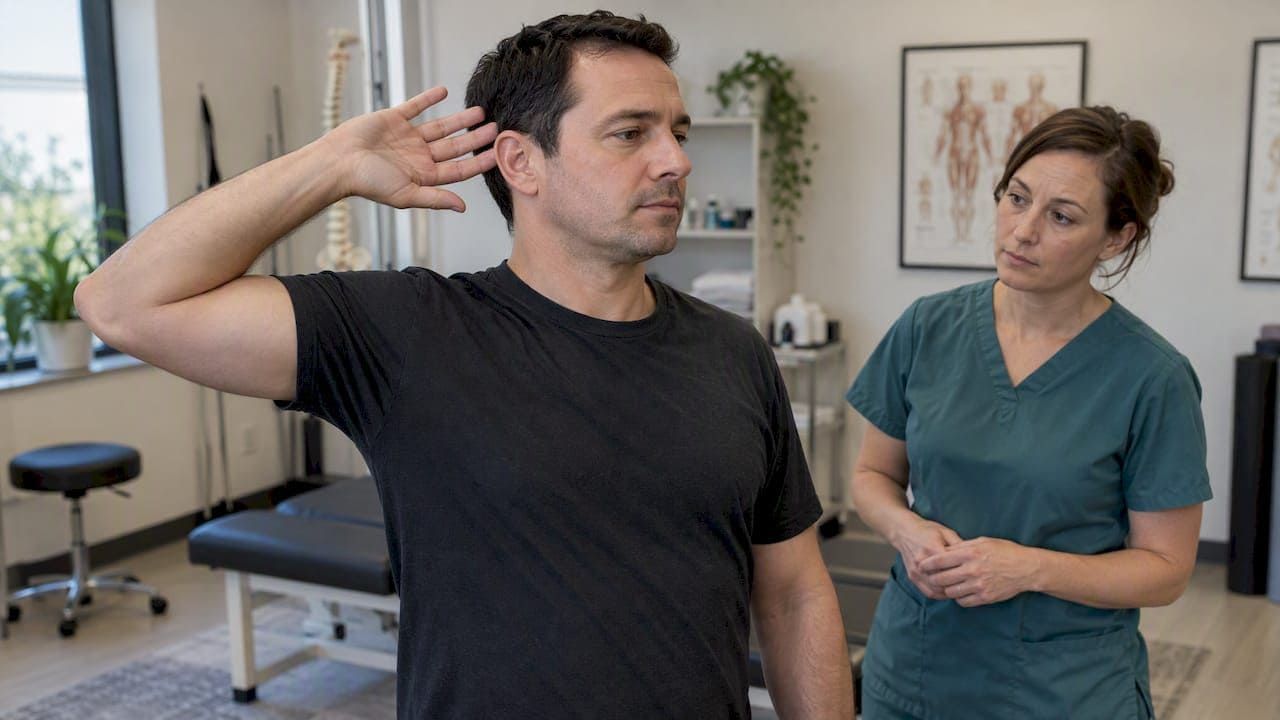
In a neutral standing posture, your ear sits roughly over your shoulder. With forward head posture, your head drifts ahead of that line. Clinicians commonly measure it with the craniovertebral angle(CVA), the angle between a horizontal line through the base of your neck and a line to your ear. A smaller angle means your head sits further forward.
It is common, and it tends to show up with neck pain. One randomized study in older adults describes FHP as significantly associated with neck pain, with higher risk in women and older people. It is also a classic feature of Upper Crossed Syndrome, which we cover next.
Why your head drifts forward
The muscle pattern behind it
Research links FHP to Upper Crossed Syndrome. The pattern has two sides:
| Tends to be weak or underused | Tends to be tight or overactive |
|---|---|
| Deep neck flexors (longus capitis and longus colli) | Pectoralis major and minor |
| Rhomboids | Upper trapezius |
| Middle and lower trapezius | Levator scapulae |
The same source notes that holding the head forward increases load on the cervical spine, and that at certain angles the head-leaning position can exert up to 3.6 times more force on the neck than neutral standing. That is the reason a posture that feels harmless at minute five can feel like a stiff, aching neck by hour six.
Exposure time is the real driver
The biggest factor most people overlook is how long they stay in the position. A clinical review in Top Doctor Magazine makes the point bluntly: no corrective program outruns 8 or more hours a day of tech neck. Phones held low, laptops on a desk, and long drives all pull the head forward. Habit changes are half the solution.
Before you start: rule out red flags
Not all neck pain with forward head posture is mechanical. Clinical guidelines emphasize screening for red flags, including neurological radiculopathy, systemic features, or a trauma history. These call for evaluation before any postural correction.
Get examined first if you have:
- Numbness, tingling or weakness running into an arm or hand
- Neck pain that began after a car accident, fall or sports collision
- Fever, unexplained weight loss, or pain that wakes you at night and does not change with position
- Severe headache with neck stiffness, or sudden loss of balance or coordination
The Mayo Clinic's guidance on when to see a doctor for neck pain is a good plain-language reference. If your pain followed a crash, our page on how to tell whether post-accident pain is serious explains what to watch for. Sudden severe symptoms, such as weakness on one side of the body or the worst headache of your life, are an emergency: call 911.
The three-step approach that works
Clinical experts describe a tiered sequence, and it is a sensible way to organize your own plan:
- Screen for red flags. Covered above.
- Assess function, not just alignment. Can you hold a chin tuck for 10 seconds? Can you keep your shoulder blades set while you reach?
- Add progressive active loading. Exercises that get harder over time, with manual therapy as an adjunct, not a substitute, for non-radicular complaints.
Treat the patient, not the number
It is tempting to chase a perfect angle in a side-view photo. Clinicians warn that focusing only on the CVA can lead to disappointment. They advise tracking function instead: deep cervical flexor endurance and scapular control correlate better with lasting symptom relief. So measure progress by how long you can hold a position, how your neck feels at 4 p.m., and how often you get headaches, not only by a photo.
Neck posture exercises that earn their place
The evidence favors programs that do two jobs at once. A systematic review of adults found that strengthening the deep neck flexors and scapular stabilizers while stretching tight anterior muscles reduces chronic neck pain and improves alignment. A separate systematic review and meta-analysis of therapeutic exercise looked at the effect of corrective exercise on postural measures in people with FHP. Related programs, such as the Kendall approach, aim to restore front-to-back muscle balance by lengthening tight pectoral and extensor muscles and strengthening weak deep neck flexors and scapular retractors.
Below is a practical routine built on those principles. It is general education, not a prescription. Stop any movement that sends pain, tingling or numbness into your arm.
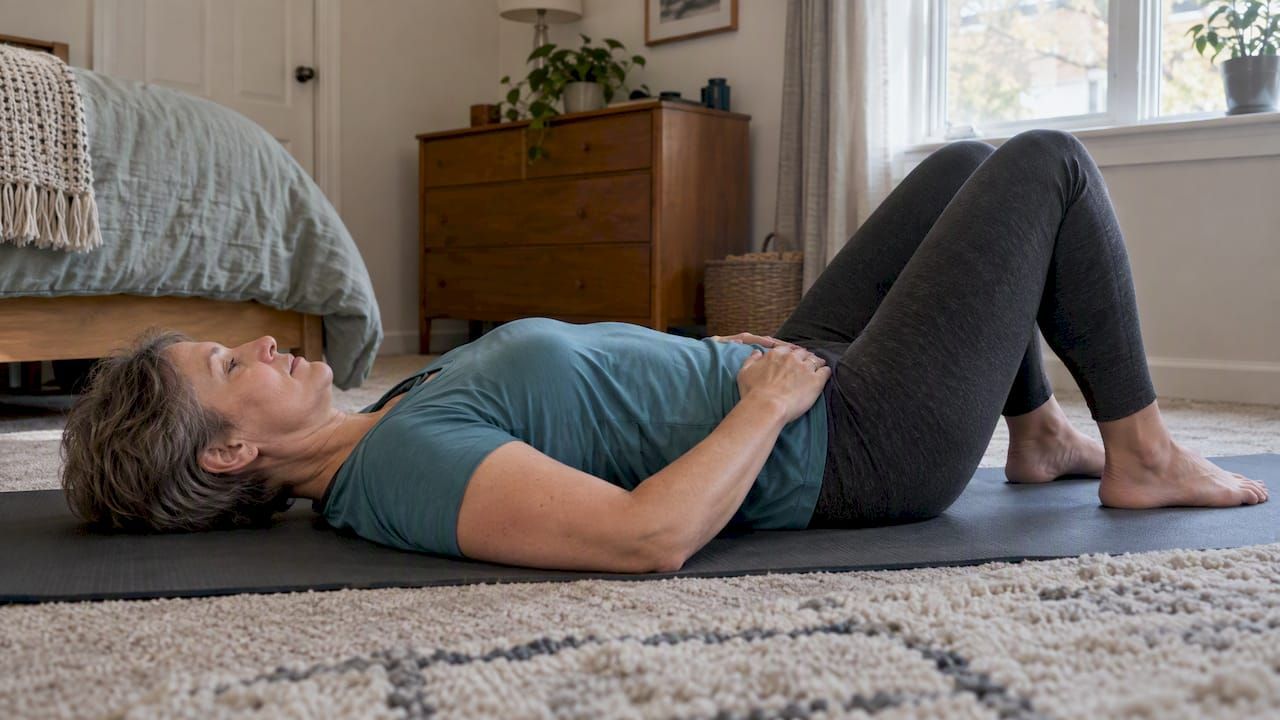
1. Supine chin tuck
Lie on your back with your knees bent. Without lifting your head, gently draw your chin toward your chest, as if making a small double chin. Hold 5 to 10 seconds, relax, and repeat 10 times. Lying down removes gravity's pull and lets you feel the deep muscles at the front of the neck without straining the big superficial ones.
When that feels easy, progress to a seated or standing chin tuck against a wall, keeping your eyes level.
2. Scapular retraction (rows)
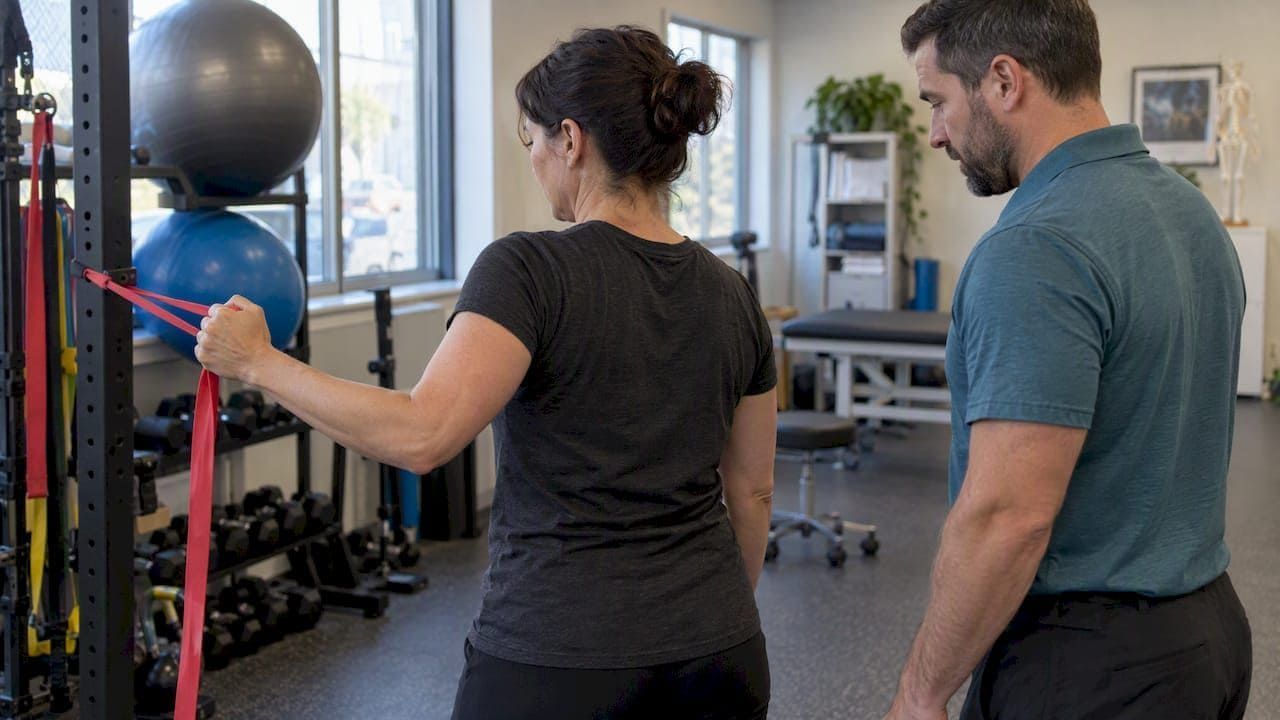
Using a light resistance band anchored at chest height, pull your elbows back and squeeze your shoulder blades gently down and together. Do 2 to 3 sets of 10 to 15. This targets the middle and lower trapezius and rhomboids that hold your shoulders back.
3. Doorway pectoral stretch
Place your forearm on a door frame with your elbow near shoulder height and step through until you feel a stretch across the chest. Hold 30 seconds, two or three times per side. Tight pecs pull the shoulders forward and drag the head with them.
4. Upper trapezius and levator scapulae stretch
Sit tall, hold the seat with one hand, and tilt your ear toward the opposite shoulder. For the levator, turn your nose toward the armpit of the side you are stretching. Hold 20 to 30 seconds, gently, two or three times per side.
5. Thoracic extension over a towel roll
A stiff upper back makes it hard for the head to come back. Lie with a rolled towel across your mid-back, hands supporting your head, and let your upper back arch gently over it for 30 to 60 seconds. A small trial found that upper thoracic mobilization with mobility exercise was one of the approaches compared for FHP, which is why we pair upper back mobility with neck work.
How often and how long
Study protocols often run about three sessions a week for four to six weeks, with progress tracked on the Neck Disability Index and a numeric pain scale. Improvements are frequently seen within three to four weeks. Your own timeline depends on how long the pattern has been building, your job and your pain level, so treat these numbers as a guide and not a promise.
Stabilization work is worth knowing about. A randomized trial compared neck stabilization exercises with dynamic exercises in people with nonspecific neck pain and FHP. Whichever style you start with, the principle is the same: control first, then load.
Fix the habits that put your head forward
Exercises are 20 minutes of your day. Posture is the other 15 or more hours. These changes matter most:
- Raise the screen. The top third of your monitor should sit near eye level. For a laptop, use a stand and a separate keyboard.
- Bring the phone up. Lift it toward eye level instead of dropping your head to meet it.
- Take short, loaded movement breaks. Every 30 to 45 minutes, stand, do five chin tucks, squeeze your shoulder blades, and walk for a minute. Clinicians who treat this pattern stress frequent, short movement breaks over occasional long sessions.
- Fix the car. Set the headrest close to the back of your head and sit back fully so you are not craning forward.
- Sleep supported. Use a pillow that keeps your neck in line with your spine, not propped forward.
- Build general strength. A stronger core and upper back make a good resting posture easier to hold.

Why results fade, and how to make them last
A common pitfall is that exercise-based improvements regress when they are not maintained. One randomized study in older adults with chronic neck pain compared approaches, including Chiropractic BioPhysics, which adds mirror-image exercises and cervical traction orthotics to address the structural side. The group using it held alignment better at three-month follow-up than standard exercise alone. That was one trial in a specific population, so it does not mean one method suits everyone. It does show that how you maintain a correction matters.
Practical takeaways:
- After the first six weeks, drop to a maintenance routine of two short sessions a week rather than stopping.
- Re-check your setup whenever your job, desk or phone habits change.
- Keep a simple log: hold time for your chin tuck, headache days per week, and pain at the end of the workday.
Where a chiropractor fits in
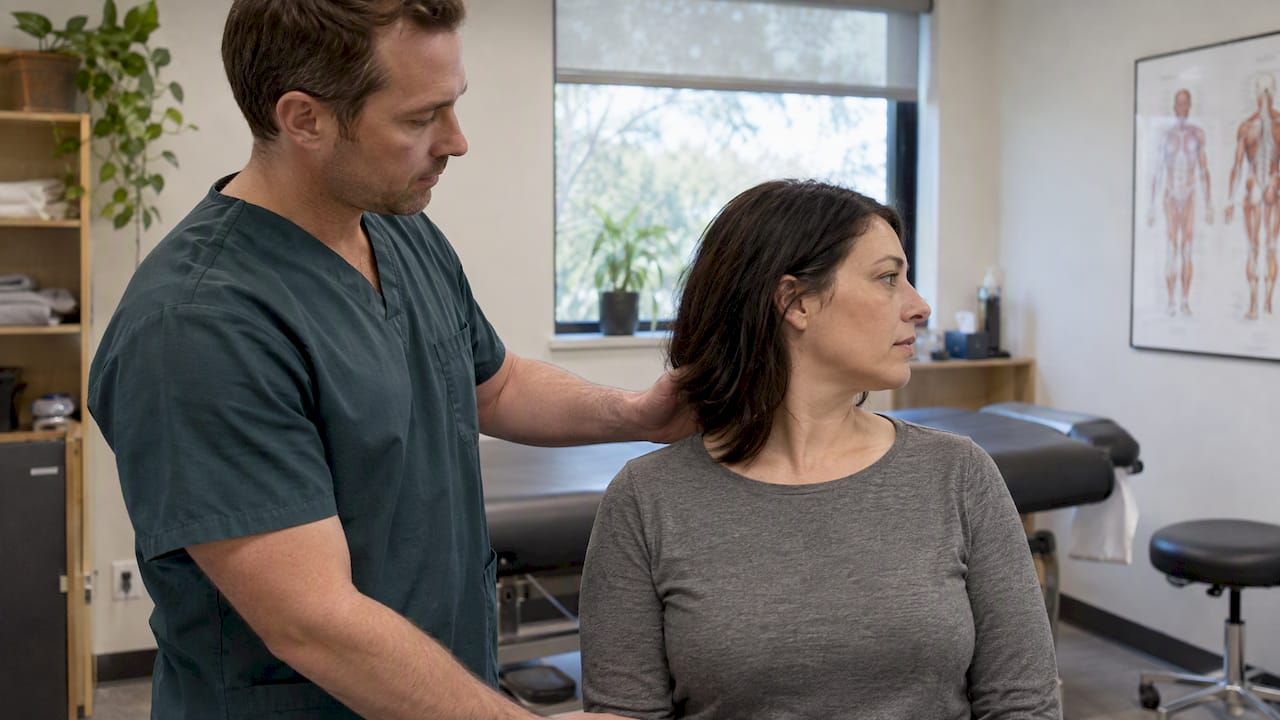
Can a chiropractor fix a forward head? Partly, and in the right role. Hands-on care can ease stiff joints and tight muscles so exercises are easier to do. But the research is clear that active work carries the long-term result. In the neck-related headache literature, experts note that isolated cervical manipulation without active exercise is often not recommended as a sole treatment, and upper cervical mobilization combined with exercise is among the preferred strategies.
That is also how a good evidence-based chiropractic visit should look: an examination, red flag screening, a plan that includes exercise, and manual work as support. Our guides on what evidence-based chiropractic means, manual therapy techniques and manual therapy versus massage explain what each piece involves. If neck pain is your main complaint, our neck pain management list and natural neck pain relief guide go deeper.
Our perspective: treat the cause, not the picture
We see forward head posture constantly in people who are not sitting badly out of laziness. They are working, driving and scrolling in a world built around screens. Our approach starts from that reality.
First, we look for the reason the head is forward, not just the fact that it is. A tight chest, a stiff mid-back, weak deep neck muscles and a desk set up for someone else's body can all produce the same side-view photo, and each needs a different plan.
Second, we do not treat adjustments as a stand-alone fix. Hands-on care can reduce pain and restore motion, but it works best when it opens the door for exercise you will actually do. That is why our plans are personalized and why our care ranges across chiropractic adjustments, manual therapy and physical rehab rather than one technique.
Third, we are honest about maintenance. Posture is a habit with a physical basis. If your day does not change, the correction will drift back. We would rather give you a short routine you can keep than a long one you abandon in week three.
Finally, we screen first. If your symptoms point to something that needs a different kind of care, we will say so and help you get to the right place.
Getting help from Essential ChiroCare
If you have tried the routine above and your neck still aches, or you would rather have your pattern assessed than guess, we can help. We provide chiropractic care and adjustments, manual therapy and physical rehab with personalized treatment plans at clinic locations in Tampa, Brandon, Sarasota, Lakeland and Pinellas Park. You can schedule online through our site, and our full list of chiropractic services shows how neck, back, whiplash and joint care fit together.
Frequently asked questions
How long does it take to correct forward head posture?
Study programs commonly run about 4 to 6 weeks at roughly three sessions a week, and improvements are often seen within 3 to 4 weeks. Results vary with how long you have had the posture and how many hours you spend at screens. Lasting change depends on keeping up a maintenance routine and fixing your daily setup.
What muscles are weak when you have forward head posture?
The deep neck flexors (longus capitis and longus colli) and the scapular stabilizers, including the rhomboids and middle and lower trapezius, tend to be weak. At the same time the pectorals, upper trapezius and levator scapulae are typically tight. This is the pattern described as Upper Crossed Syndrome.
Can a chiropractor fix forward head posture?
A chiropractor can examine you, screen for red flags, and use adjustments and manual therapy to ease stiffness and pain. The most reliable results come when that care is paired with active strengthening and stretching, plus changes to your screen and work habits. Manual care alone is not usually enough.
How do I stop my neck from going forward?
Start with your setup: raise your screen to eye level and lift your phone instead of dropping your head. Then do short movement breaks with chin tucks and shoulder blade squeezes every 30 to 45 minutes. Add the strengthening and stretching routine three times a week.
Can exercises make forward head posture worse?
They can if they are done with too much force or poor form, or if the neck pain actually comes from something that needs medical care. Stop and see a clinician if exercises increase pain, or cause numbness, tingling or weakness in your arm. Gentle, controlled chin tucks are a safe place to begin for most people without red flags.
Sources
- Effectiveness of Therapeutic Exercises in Reducing Neck Pain and Correcting Forward Head Posture in Adults: A Systematic Review
- Tech-Induced Posture Decline: A Clinical Approach, Top Doctor Magazine
- Forward head posture and Upper Crossed Syndrome study
- A Comparison of Two Forward Head Posture Corrective Approaches in Elderly with Chronic Non-Specific Neck Pain (JCM)
- Same study, PubMed Central full text
- Effectiveness of Therapeutic Exercise on Forward Head Posture: Systematic Review and Meta-analysis (PubMed)
- Kendall-based programs, ScienceDirect
- ELDOA versus upper thoracic mobilization for forward head posture
- Neck stabilization versus dynamic exercises, BMC Musculoskeletal Disorders
- The cervical spine in tension type headache
- Neck pain: when to see a doctor, Mayo Clinic
Recommended