Everyday Movements to Avoid for a Pain-Free Back
Everyday Movements to Avoid for a Pain-Free Back
The everyday movements most likely to cause or worsen back and joint pain are prolonged sitting, bending with a rounded back, twisting while carrying a load, looking down at a phone for extended periods, repetitive overhead reaching, carrying heavy bags on one side, high-impact running on unstable joints, aggressive yardwork without breaks, moving on slippery or uneven surfaces, and forcing your range of motion past a pain point. The single rule of thumb that covers all of them: if it causes sharp pain, stop; otherwise, modify to reduce load, add support, or use a lower-impact alternative.
The most important behavioral change you can make right now costs nothing: break up prolonged sitting every 30–60 minutes. Stand, walk to the kitchen, do a few shoulder rolls. Clinicians consistently flag this interval because spinal discs lose fluid and facet joints stiffen faster than most people realize when you stay still.
Quick reference: the highest-risk everyday movements to avoid or modify
- Sitting for extended periods without moving
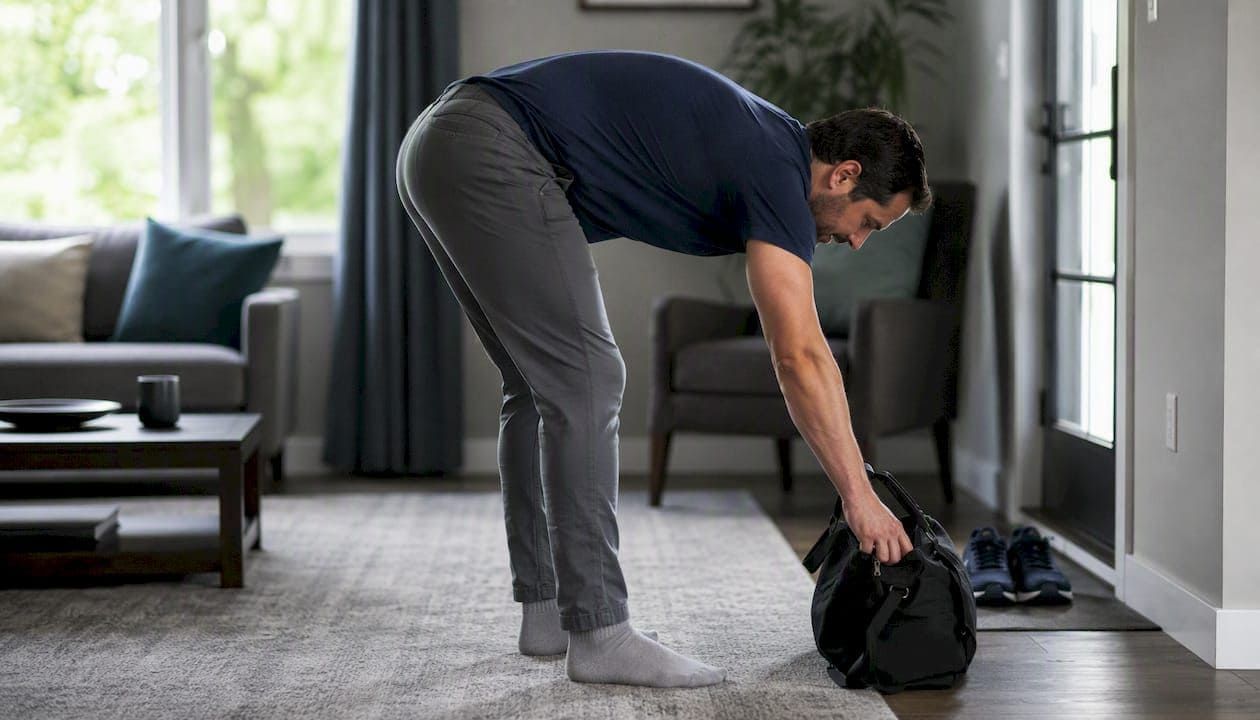
- Bending forward with a rounded back to pick something up
- Twisting your torso while holding a load
- Looking down at a phone or laptop for long stretches (tech neck)
- Repetitive vacuuming, mopping, or shoveling without posture breaks
- Carrying a heavy bag, groceries, or backpack on one side only
- Reaching overhead repeatedly without core engagement or support
- Running or jumping on hard surfaces when joints are unstable
- Stepping on slippery floors or uneven terrain without grip footwear
- Forcing a stretch or range of motion past the point of pain
Key Takeaways
Modifying the everyday movements that load your spine and joints incorrectly, combined with a short daily exercise routine and consistent breaks, reduces pain risk more reliably than any single treatment.
| Point | Details |
|---|---|
| Break every half hour or so | Stand, walk, or stretch to interrupt disc compression and joint stiffness from prolonged sitting. |
| Hinge, don't round | Use a hip hinge and bent knees for all lifting; keep the load close and never twist under weight. |
| Daily routine matters | Cat–cow, pelvic tilts, wall angels, and chin retractions build the deep stability that protects your spine. |
| Stop at sharp pain | Pain during movement is a signal to modify or stop; worsening symptoms over 48–72 hours need clinical evaluation. |
| Essentialchirocare | Provides movement assessment, chiropractic adjustments, rehab, and spinal decompression at clinics across West Central Florida. |
Table of Contents
- The top everyday movements to avoid, ranked by pain risk
- Why each movement causes harm and how to do it safely
- How to stay active safely every day
- Ergonomic and behavioral habits that cut cumulative strain
- Warning signs that mean you should stop and seek care
- Essentialchirocare clinic-backed do's and don'ts
- Common compensatory movements that quietly raise your injury risk
- Why core strength is the foundation of safe everyday movement
- The gap between knowing what to change and actually changing it
- Essentialchirocare can evaluate your movement and build a plan
- Sources
The top everyday movements to avoid, ranked by pain risk
The list below is ordered by how often these movements show up as triggers in clinical practice, from the most universal to the more situational.
- Prolonged sitting — compresses lumbar discs and shortens hip flexors; stand and reset every 30–60 minutes.
- Rounding the back to pick up objects — shifts shear force onto the posterior disc; squat and hinge instead, keeping the load close.
- Twisting while carrying — asymmetric loading under rotation multiplies shear on the lumbar spine; pivot your feet instead of rotating your trunk.
- Tech neck (looking down at screens) — every inch the head drops forward adds roughly 10 lbs of effective load on the cervical spine; raise the screen to eye level.
- Repetitive household chores without breaks — vacuuming, mopping, and shoveling repeatedly overload lumbar and SI structures when done in long unbroken sessions; break every 10–15 minutes and switch sides.
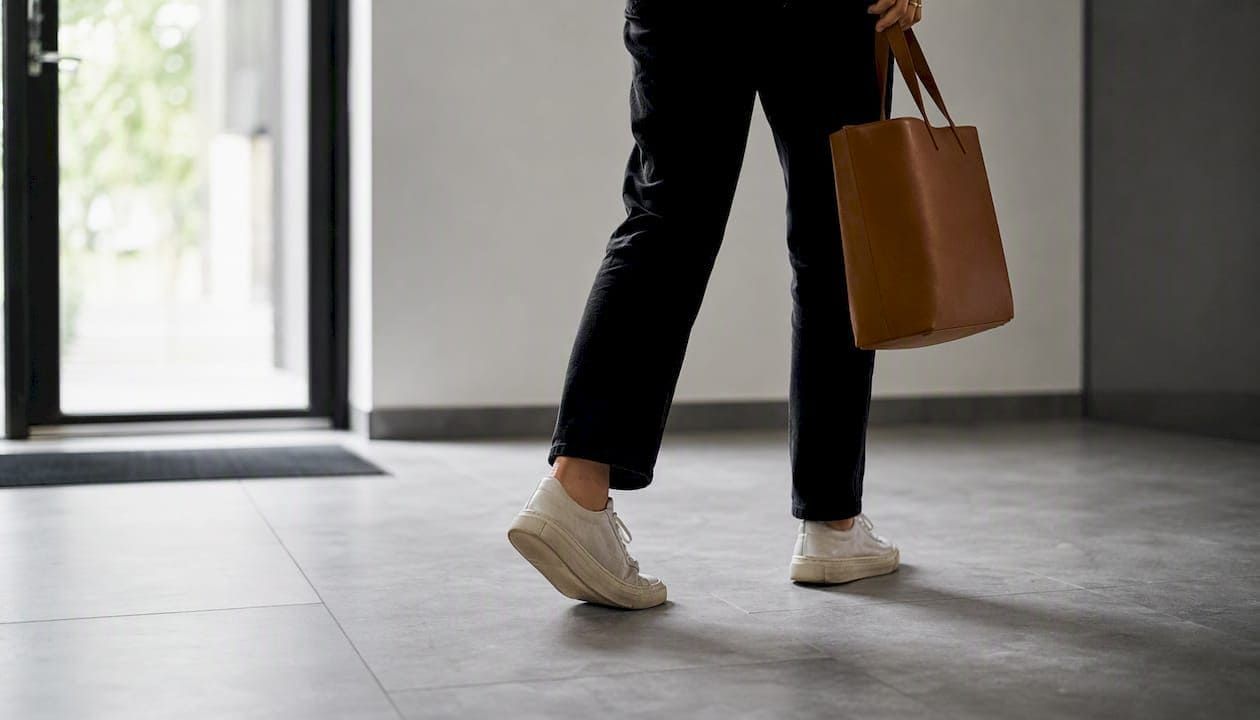
- Single-side carrying — a heavy tote or grocery bag on one shoulder forces the opposite hip to hike, compressing the lumbar spine asymmetrically; split the load or use a backpack.
- Repetitive overhead reaching — sustained shoulder elevation without core stability loads the cervical and upper thoracic spine; use a step stool and engage your core before reaching.
- High-impact running on hard surfaces — ground reaction forces travel straight to unstable hips or knees; swap to walking, cycling, or swimming when joint stability is compromised.
- Moving on slippery or uneven terrain — a sudden slip triggers a reflexive muscle contraction that can strain lumbar paraspinals or sacroiliac ligaments; grip-soled shoes and cleared walkways matter more than most people think.
- Forcing range of motion past pain — pain during movement is a signal to stop or modify, not push through; if modifying the movement doesn't remove the pain, skip it and seek evaluation.
Why each movement causes harm and how to do it safely
Sitting too long
Sustained spinal compression reduces disc hydration and loads the posterior ligaments. The facet joints, designed for movement, begin to ache when held in one position. The fix is not a "perfect" posture. No single posture is ideal for a full day; what matters is changing positions frequently and using lumbar support to reduce the load during each position.
Modification steps: Set a timer for about every half hour. Stand, walk briefly, or do some light movement. Keep a small lumbar roll behind your lower back when seated. Feet flat on the floor, knees at roughly 90 degrees.
Bending with a rounded back
When you round your lumbar spine to reach the floor, the posterior disc wall takes the full compressive and shear load. Over time, repetitive bending and awkward postures are linked to higher rates of musculoskeletal injury and chronic low-back pain. A single heavy lift with poor mechanics can cause an acute herniation; repeated light lifts with the same mechanics cause the same damage more slowly.
Safe lifting checklist:
- Feet hip-width apart, toes slightly out
- Hinge at the hips first, then bend the knees
- Keep the object close to your body
- Engage your core before you lift ("brace like you're about to be punched")
- Lift with your legs, not your back
- Never twist while the load is in your hands; pivot your feet
For anything heavier than you can comfortably hold with both arms, use a dolly, a cart, or ask for help. The assistive device is not a sign of weakness; it is the correct tool.
Twisting while carrying a load
Rotation under load multiplies the shear force on spinal discs and the sacroiliac joint. The safest cue: feet first, body follows. Before you change direction while holding anything, move your feet to face the new direction, then let your torso follow. This one habit change eliminates the majority of twist-related lumbar injuries.
Tech neck
The cervical spine is designed to hold a head that sits directly over the shoulders. Drop it 30 degrees forward to look at a phone and the effective load on your neck roughly triples. Do this for hours a day and the deep neck flexors weaken while the posterior cervical muscles shorten and fatigue. Raise your phone or laptop to eye level. If you work at a desk, position the top of your monitor at or just below eye height.
Repetitive household chores
Vacuuming, mopping, and shoveling share a common injury pattern: repeated forward flexion with a slight rotation, often with a long lever arm (the handle). Break chores into shorter segments with breaks in between. Alternate sides when possible. For shoveling, use an ergonomic handle, push rather than throw when you can, and keep loads small.
Single-side carrying
A heavy bag on one shoulder forces the spine into a lateral curve to compensate. Over weeks, this pattern shortens the quadratus lumborum on one side and creates a predictable low-back trigger point. Split groceries into two bags of equal weight, or switch to a backpack that distributes load symmetrically.
Overhead reaching
Reaching overhead without engaging the core transfers the load directly to the cervical and upper thoracic spine. Use a step stool so your arms stay below shoulder height when possible. When you must reach higher, brace your core, keep your ribs down, and avoid arching your lower back to gain extra height.
High-impact running on unstable joints
When the pelvis or knee joints lack stability, transitioning to low-impact activities like swimming or cycling reduces progressive joint wear. This is not permanent; it is a bridge while you build the stability needed to return to higher-impact activity safely. For people with osteoporosis or significant joint instability, high-impact exercise guidelines recommend a staged return under clinical supervision.
Slippery or uneven surfaces
A sudden slip triggers a reflexive full-body contraction. The lumbar paraspinals and SI ligaments are particularly vulnerable because they fire hard and fast to prevent a fall. Grip-soled footwear, removing loose rugs, and keeping walkways clear are not overcautious measures; they are genuine injury prevention.
Forcing range of motion
Stretching past the point of pain is not productive. Pain is the tissue's signal that load has exceeded its current tolerance. Gentle, pain-free range of motion is therapeutic. Aggressive end-range forcing, especially under load, is how muscles and ligaments tear.
How to stay active safely every day
Low-impact movement is the best medicine for most musculoskeletal conditions. Walking, cycling, swimming, and elliptical training keep joints mobile and muscles active without the ground-reaction forces that stress unstable structures. Clinicians recommend steady daily movement over sporadic intense sessions, because the "weekend warrior" pattern, sedentary all week then hard exercise on Saturday, is a predictable injury mechanism.
A 5–10 minute daily spine and joint routine (do in order):
- Cat–cow (10 reps): On hands and knees, inhale as you drop your belly and lift your head (cow), exhale as you round your spine toward the ceiling (cat). Moves the lumbar spine through its full flexion-extension range and pumps fluid through the discs.
- Pelvic tilt (10 reps): Lying on your back, knees bent, feet flat. Gently flatten your lower back against the floor by tightening your abs, hold 3 seconds, release. Pelvic tilts and wall angels are among the most consistently recommended posture exercises in clinical practice.
- Wall angels (10 reps): Stand with your back flat against a wall, arms in a "goalpost" position. Slowly slide your arms up the wall and back down, keeping contact throughout. Strengthens the lower trapezius and opens the chest.
- Chin retraction (10 reps): Sitting or standing, gently draw your chin straight back (not down) to create a "double chin." Reactivates the deep cervical flexors weakened by tech-neck posture.
- Standing glute activation (10 reps each side): Stand on one leg, squeeze the glute of the standing leg for 3 seconds, release. Builds the hip stability that protects the lumbar spine during walking and lifting.
- Gentle thoracic rotation (5 reps each side): Seated in a chair, cross your arms over your chest and rotate slowly left and right. Keeps the mid-back mobile, which reduces compensatory strain on the lumbar spine.
Low-impact swaps:
- Running on pavement → brisk walking, pool walking, or cycling
- Heavy gym lifts → resistance bands or bodyweight with controlled tempo
- High-intensity interval training → steady-state swimming or elliptical
Pro Tip: Avoid the "good day" trap. When pain eases, the instinct is to catch up on everything you skipped. Doing too much on a good day commonly triggers a flare the next morning. Pace activity evenly across the week rather than spiking on days you feel well.
Ergonomic and behavioral habits that cut cumulative strain
Break schedule
Move every 30–60 minutes. A micro-break does not need to be a workout: stand up, walk to another room, do 5 shoulder rolls or a standing hip hinge. The goal is to interrupt the static loading pattern before tissue fatigue accumulates.
Workstation setup
- Monitor top at or just below eye level
- Keyboard and mouse close enough that elbows stay near 90 degrees
- Lumbar support maintaining the natural inward curve of the lower back
- Feet flat on the floor or on a footrest
- Screen distance roughly arm's length
Footwear and surfaces
Shoes with worn-out soles, thin flat soles, or high heels alter your gait mechanics and shift load up the kinetic chain to the knees, hips, and lumbar spine. Replace athletic shoes every 300–500 miles of use. At home, avoid walking on hardwood or tile in socks; grip-soled slippers or shoes reduce slip risk significantly. Remove loose rugs and extension cords from high-traffic areas.
Safe-lifting rules (condensed)
- Hip hinge first, then bend knees
- Keep load within 12 inches of your body
- Brace core before lifting
- Pivot feet to change direction; never twist at the waist under load
- If it feels too heavy, it is too heavy; use a cart or ask for help
Workstation and lifting quick reference:
| Habit | Risk if skipped | Quick fix |
|---|---|---|
| Monitor at eye level | Tech neck, cervical strain | Raise monitor or use a stand |
| Lumbar support | Disc compression, fatigue | Small roll or lumbar cushion |
| Break every 30–60 min | Disc dehydration, hip flexor tightness | Phone timer or standing desk |
| Grip-soled footwear | Slip-and-fall lumbar strain | Replace worn shoes; grip slippers at home |
| Two-handed or split loads | Asymmetric lumbar compression | Two bags, backpack, or cart |
Warning signs that mean you should stop and seek care
Most movement-related pain responds to rest, modification, and gentle exercise within a few days. Some symptoms signal something more serious.
Red flags that warrant prompt evaluation:
- Progressive leg weakness or difficulty walking
- Loss of bowel or bladder control
- Severe, unrelenting pain that does not ease with any position change
- New numbness or tingling radiating down an arm or leg
- Fever combined with back or neck pain
- Pain following a high-energy trauma (fall, collision)
- Symptoms worsening over 24–72 hours despite rest and modification
Immediate self-care while arranging care:
- Relative rest: avoid the aggravating movement, but stay gently mobile
- Ice for the first 24–48 hours on acute injuries; heat for chronic muscle tension
- Avoid any movement that reproduces sharp or radiating pain
- If pain started after an accident, chiropractic care for personal injury can be part of the evaluation and recovery plan
Triage summary:
| Severity | Signs | Action |
|---|---|---|
| Mild | Dull ache, eases with movement or rest | Modify activity, apply ice or heat, monitor 48–72 hours |
| Moderate | Pain persisting more than 72 hours, limited range of motion | Schedule clinical evaluation within a few days |
| Emergency | Neurologic changes, loss of bowel/bladder control, trauma | Seek same-day or emergency care immediately |
Essentialchirocare clinic-backed do's and don'ts
Do:
- Use assistive devices (carts, step stools, lumbar supports) without hesitation
- Take micro-breaks every 30–60 minutes, even on busy days
- Stage household tasks: do half the vacuuming, rest, then finish rather than completing it all in one session
- Maintain gentle daily movement even on painful days (short walks, the routine above)
- Seek a personalized spine care routine from a clinician if your symptoms are recurring
Don't:
- Push through sharp, shooting, or radiating pain
- Lift heavy loads without warming up and bracing your core
- Sit or stand in one position for more than 60 minutes
- Assume that pain after exercise is normal and will pass; some pain is a warning
- Skip footwear with adequate support on hard floors or uneven ground
Short daily spine care routine (clinician-recommended, 5–8 steps):
- Morning: 5 cat–cow repetitions before getting out of bed
- After breakfast: 10 pelvic tilts on the floor
- Mid-morning: stand and do 5 wall angels against a doorframe
- Midday: 10 chin retractions at your desk
- Afternoon: a 5-minute walk, even just around the building
- Evening: gentle thoracic rotation in a chair, 5 reps per side
- Before bed: lying hip flexor stretch, 30 seconds per side
Pro Tip: Stage repetitive chores in two or three short sessions rather than one long one. Vacuuming the whole house in 45 minutes is a common trigger for SI joint flares; doing two rooms, resting, then finishing is not laziness — it is smart load management.
This guidance is general and educational. For persistent, severe, or worsening symptoms, seek a personalized evaluation from a licensed clinician.
Common compensatory movements that quietly raise your injury risk
When one area hurts, the body reroutes movement to protect it. This is useful in the short term and harmful over weeks. A sore left knee leads to a right-hip hike, which loads the lumbar spine asymmetrically. A stiff thoracic spine leads to excessive lumbar rotation during reaching, which strains the lower back to compensate for what the mid-back won't do.
The most common compensatory patterns to watch for:
- Hiking one hip when walking to avoid loading a painful knee or ankle
- Arching the lower back excessively when reaching overhead because the thoracic spine is too stiff to extend
- Leaning to one side when sitting to unload a painful SI joint, which then overloads the opposite side
- Shrugging the shoulders during arm movements when the rotator cuff is weak or painful
- Holding the breath and bracing rigidly during any movement that causes fear of pain, which increases intra-abdominal pressure and reduces movement quality
The problem with compensations is that they feel like solutions. The original pain may ease, but the compensatory pattern creates a new load concentration elsewhere. Chiropractic care and physical rehabilitation address both the original problem and the compensatory pattern, which is why movement assessment matters as much as pain relief.
Why core strength is the foundation of safe everyday movement
The core is not just your abs. It includes the transverse abdominis, multifidus, pelvic floor, and diaphragm working together as a pressure system that stabilizes the spine before your arms or legs move. When this system fires correctly, it reduces the load on passive structures like discs and ligaments during every movement on the list above.
Weak or poorly coordinated core muscles mean the spine relies on its passive structures for stability. Discs, ligaments, and facet joint capsules are not designed to be primary stabilizers; they are designed to be the last line of defense. When they become the first, injury risk rises with every repetition.
The good news: the exercises in the daily routine above (cat–cow, pelvic tilts, glute activation) are specifically chosen because they train the deep stabilizers, not just the superficial muscles you can see in a mirror. Consistency matters more than intensity here. Ten pelvic tilts every morning for three weeks does more for lumbar stability than one intense core workout per week.
For readers who want to go further, foods that support joint health can complement a movement-focused approach by reducing systemic inflammation that slows tissue recovery.
The gap between knowing what to change and actually changing it
Most people reading this article already know they sit too long, lift badly, and look at their phones too much. The gap is not information; it is expectation management.
Changing movement habits does not produce results in a day. The tissues that have been loaded incorrectly for months or years need weeks of consistent, correct loading to adapt. The mistake most people make is trying a modification for three days, feeling no different, and concluding it doesn't work. Three days is not enough time for connective tissue to remodel.
The other common mistake is the opposite: feeling better after a week and returning immediately to the full load that caused the problem. Pain relief is not the same as tissue recovery. The disc, ligament, or muscle that was stressed is still in the process of healing when the pain stops.
Pace your return. Measure progress in weeks, not days. A short daily routine done consistently beats an aggressive rehabilitation sprint followed by a flare. Rest is not the goal; paced, progressive movement is. The research on recovery consistently points to the same principle: steady, low-intensity activity across the week outperforms sporadic intense effort, both for pain reduction and for long-term joint health.
Essentialchirocare can evaluate your movement and build a plan
If modifying movements at home has not resolved your pain within two to three weeks, or if your symptoms are recurring, a clinical evaluation gives you something self-management cannot: a precise picture of which structures are involved and why the pain keeps coming back.
Essentialchirocare offers chiropractic care, physical rehabilitation, manual therapy, and spinal decompression across multiple clinic locations in West Central Florida, including Tampa, Brandon, Sarasota, Lakeland, and Pinellas Park. Clinicians assess your movement mechanics directly, identify compensatory patterns, and build a plan specific to your load tolerance and goals. That is a different outcome than a generic exercise list. Book an appointment online or contact the nearest location to get a movement assessment and a tailored recovery plan.
Sources
This article is general information, not a substitute for advice from a qualified doctor. Consult a qualified healthcare professional about your own circumstances before acting on anything here.
Recommended