

Clinic Backed Chiropractic Care for Pinched Nerve Relief in 4–6 Weeks
Chiropractic care is a reasonable first-line, non-surgical option for many pinched nerves, and it lines up with the conservative-care approach clinics recommend before considering surgery. Most people notice real improvement after starting conservative care. That said, sudden weakness, loss of bladder or bowel control, or numbness in the groin area needs emergency care, not a chiropractic appointment.
TL;DR:
- Chiropractic care typically requires multiple visits over several weeks, with most patients seeing improvement within four to six weeks of consistent treatment.
- Initial evaluations include neurologic screening—such as muscle strength, reflex tests, and provocation maneuvers—to rule out serious conditions and determine treatment suitability.
- Home strategies, like ice in the first 48 hours and gentle nerve-gliding exercises under professional guidance, can support recovery but are not standalone solutions.
- Severe symptoms like loss of bladder control, worsening weakness, or saddle numbness demand urgent medical attention rather than chiropractic treatment.
- Chiropractic techniques for pinched nerves involve spinal adjustments, decompression, manual therapy, and rehab exercises, tailored to the nerve's location and irritability level.

Table of Contents
- What Is a Pinched Nerve, and What Does It Feel Like?
- What Chiropractic Techniques Treat a Pinched Nerve?
- What Happens During Your First Chiropractic Visit?
- How Long Does It Take to Recover From a Pinched Nerve?
- Is Chiropractic Care Safe for a Pinched Nerve?
- What Can You Do at Home to Support Recovery?
- How Essential ChiroCare Approaches Pinched Nerve Cases
- The Real Gap Between What Gets Promised and What Gets Delivered
- Ready to Get Your Pinched Nerve Evaluated?
- Sources
- FAQ
What Is a Pinched Nerve, and What Does It Feel Like?
A pinched nerve, known clinically as radiculopathy, happens when a nerve root gets compressed or irritated by a disc, bone spur, or tight surrounding tissue. It shows up most often in the neck (cervical radiculopathy) and lower back (lumbar radiculopathy), though nerves can also get trapped at narrow passageways like the wrist or elbow.
The symptoms are usually distinctive enough to recognize on your own. According to Mayo Clinic, a pinched nerve typically causes:
- Sharp, radiating pain that travels down an arm or leg rather than staying in one spot
- Tingling or a pins-and-needles sensation
- Numbness in the affected area
- Muscle weakness, sometimes noticeable as a weaker grip or a leg that feels unsteady
Symptoms often get worse with specific movements, like turning your head to check a blind spot or sitting for a long stretch at a desk. That movement pattern is actually a useful clue for diagnosis. If your symptoms feel more like burning or widespread tingling in both feet without a clear mechanical trigger, that pattern can point toward peripheral neuropathy or a systemic cause instead, which is why a proper exam matters before starting any treatment plan.
What Chiropractic Techniques Treat a Pinched Nerve?
Chiropractic treatment for nerve pain isn't a single move. It's a sequence of techniques chosen based on which nerve is affected, how irritated it is, and how your body responds session to session.
- Spinal adjustments and joint mobilization. These restore normal motion to the vertebral joints next to the compressed nerve, which can reduce the mechanical irritation causing your symptoms.
- Spinal decompression and flexion-distraction. Also called LVVA-SM (low velocity, variable amplitude spinal manipulation), this technique gently stretches the spine to create space around a disc or nerve root. Research on LVVA-SM shows short-term analgesic effects in neuropathic pain, giving this approach a genuine mechanistic basis rather than just anecdotal support. It's often the technique of choice for disc-related compression, including chiropractic for herniated disc cases where a thrust adjustment might be too aggressive early on.
- Soft tissue and manual therapy. Muscle tightness around a compressed nerve makes everything worse. Manual therapy and instrument-assisted techniques loosen that tissue so the nerve has less pressure working against it from multiple directions.
- Therapeutic exercise and posture coaching. Once acute pain settles, the plan shifts toward rebuilding strength and correcting the postural habits that contributed to the compression in the first place.
Pro Tip: Ask your chiropractor which technique they're using and why for your specific case. A good provider will explain the reasoning in plain terms, not just say "we'll adjust you and see."
What Happens During Your First Chiropractic Visit?
Your first visit is mostly information gathering, not treatment. Expect a detailed history of when symptoms started, what makes them worse, and any past injuries, followed by a neurologic screening that checks:
- Muscle strength in the affected arm or leg
- Reflexes at the knee, ankle, or wrist
- Sensation to light touch across specific skin regions
- Provocation tests, like the Spurling test for the neck, that reproduce your symptoms to confirm the source
If your exam shows progressive weakness, a history of significant trauma, or symptoms that don't fit a typical mechanical pattern, imaging or referral to a medical provider comes next rather than immediate treatment. This is a normal part of a thorough workup, not a sign something has gone wrong.
For nerves that are highly irritable, early visits favor gentler techniques and shorter sessions, with frequency scaled back once symptoms stabilize. Chiropractors coordinate with physicians, physical therapists, or spine specialists whenever a case needs input beyond conservative musculoskeletal care.
How Long Does It Take to Recover From a Pinched Nerve?
Many people see measurable improvement within a few weeks of starting conservative care, though the timeline shifts depending on how long you've had symptoms and any underlying health conditions.
What recovery usually looks like: pain intensity drops first, followed by improved range of motion, then gradual strength gains, with a return to normal activity as the final milestone.
Chronic cases, meaning symptoms present for several months before treatment starts, tend to take longer to resolve than nerves compressed for just a week or two. Diabetes, obesity, and repetitive occupational strain can also slow the pace. If strength doesn't improve or symptoms worsen despite weeks of consistent conservative care, that's the point to loop in a spine specialist for imaging and a broader discussion of options, including whether standard treatments like injections or surgery make sense for your case.
Is Chiropractic Care Safe for a Pinched Nerve?
Chiropractic care for nerve issues is generally well tolerated, but knowing the warning signs protects you from ignoring something serious. Seek urgent medical attention if you notice:
- Progressive motor weakness that gets worse day by day, not better
- Loss of bladder or bowel control
- Numbness in the saddle region (inner thighs, groin, or buttocks)
- Fever following a back or neck injury
- Severe trauma, like a fall or car accident, preceding new nerve symptoms
Oddly enough, a sudden disappearance of pain isn't always good news. It can sometimes signal severe nerve dysfunction rather than recovery, especially when it comes with new numbness or weakness, so mention any abrupt symptom change to your provider right away.
Routine side effects are far more common and far less concerning: mild soreness for a day or two after an adjustment, or a brief, temporary uptick in symptoms as tissue adjusts to new movement patterns. A chiropractor trained to spot the difference between normal treatment response and a red flag will tell you when a case needs a referral rather than continued in-office care.

What Can You Do at Home to Support Recovery?
Home care won't fix a pinched nerve on its own, but it keeps you comfortable between visits and speeds up what happens in the clinic.
- Use ice for the first 48 hours if inflammation feels sharp and acute, then switch to heat to relax surrounding muscle tension.
- Modify activity, don't eliminate it. Complete rest often stiffens things up further. Short walks and gentle movement usually beat lying flat all day.
- Try nerve-gliding movements your provider demonstrates in person. These are gentle, specific motions designed to let a nerve move more freely through its surrounding tissue. They're easy to get wrong without guidance, so learn them from a clinician before doing them unsupervised.
- Adjust your desk and driving setup. Raise your monitor to eye level, support your lower back with a cushion, and adjust your headrest so your neck isn't held in a forward or rotated position for hours at a time.
Pro Tip: Stop any home exercise immediately if it increases tingling, numbness, or weakness rather than easing it, and call your chiropractor before trying it again.
How Essential ChiroCare Approaches Pinched Nerve Cases
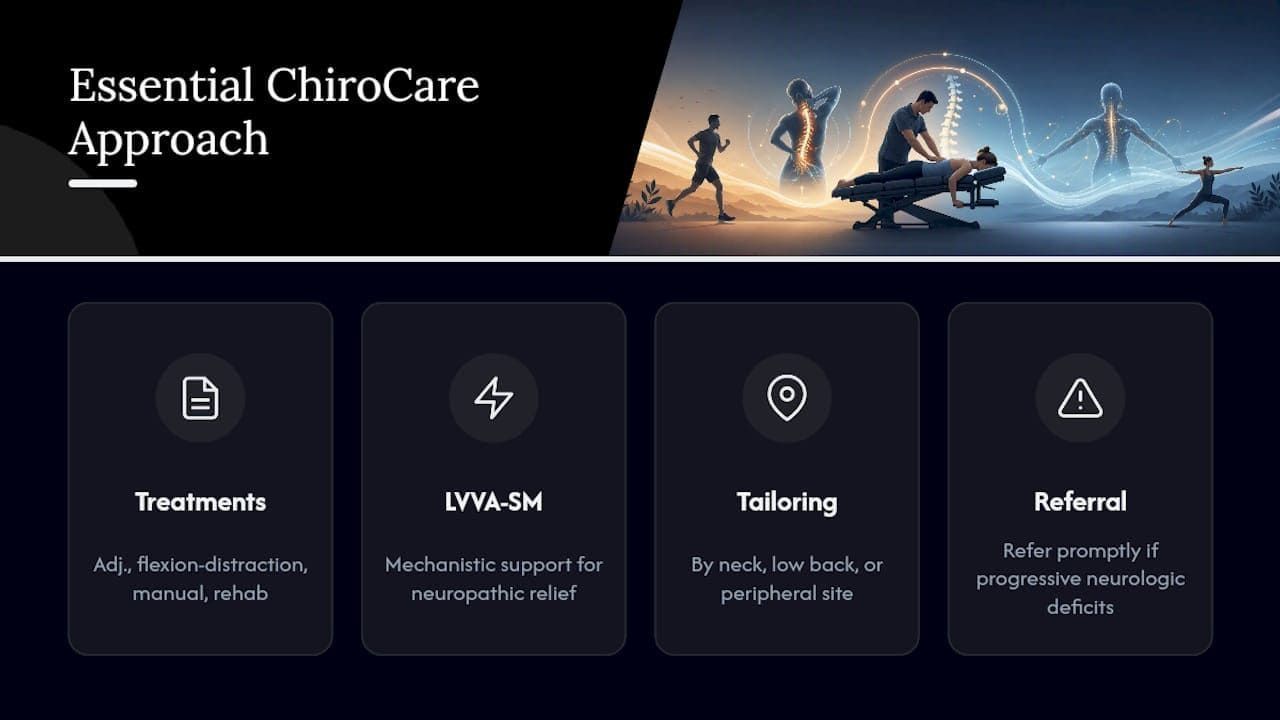
Essential ChiroCare treats pinched nerve pain with a combination of spinal adjustments, flexion-distraction decompression, manual therapy, and progressive rehab exercises, tailored to whether the compression sits in the neck, low back, or a peripheral site. That mix reflects the same conservative-care-first standard major clinics recommend and the mechanistic support behind LVVA-SM for neuropathic pain relief. Cases with progressive neurologic deficits get referred out promptly.
The Real Gap Between What Gets Promised and What Gets Delivered
Most articles on this topic oversell speed and undersell screening. The truth is messier and more useful: chiropractic care doesn't fix a pinched nerve in one visit, and any provider who implies otherwise is setting you up for disappointment. What actually moves the needle is the boring part, the neurologic exam that rules out something serious before treatment even starts.
Where conventional advice falls short is treating "see a chiropractor" as interchangeable with "see a massage therapist." They're not the same service. A massage therapist can loosen tight muscles around a compressed nerve, which helps, but only a chiropractor trained in neurologic screening can tell you whether that muscle tension is the whole story or a symptom of something that needs imaging.
If you take one thing from this article, prioritize the exam over the treatment. A provider who spends real time on strength testing, reflexes, and provocation maneuvers before ever touching an adjustment table is doing the part of the job that actually protects you.
Ready to Get Your Pinched Nerve Evaluated?
If home care and modified activity haven't eased your symptoms after a week or two, an in-person evaluation beats guessing at what's causing the compression. Expert chiropractic clinics offer spinal adjustments, flexion-distraction decompression, manual therapy, and rehab progression under one roof, so your care plan can shift as your nerve responds without bouncing you between separate providers.
Bring a list of your symptoms, when they started, any imaging you've already had, and your current medications to your first visit. It speeds up the neurologic exam considerably. You can schedule online or by phone, and appointments typically start with the same history and screening process described earlier in this article, not a treatment you weren't expecting. Start by visiting the chiropractic care page to book your evaluation.
This article is general information, not a substitute for advice from a qualified doctor. Consult a qualified healthcare professional about your own circumstances before acting on anything here.
Sources
FAQ
What Is the Fastest Way to Fix a Pinched Nerve?
There's no true shortcut, but combining activity modification with early conservative care, chiropractic adjustments, manual therapy, or physical therapy, gives you the best odds of faster relief compared to rest alone.
Is It Better to See a Chiropractor or a Massage Therapist for a Pinched Nerve?
A chiropractor is the better first stop because they can perform a neurologic exam to identify the source of compression, while a massage therapist addresses muscle tension but can't screen for nerve involvement.
How Many Chiropractic Visits Does It Take to Fix a Pinched Nerve?
Many people notice improvement within four to six weeks of consistent care, though the exact number of visits depends on how long you've had symptoms and how severe the compression is.
What Should You Not Do When You Have a Pinched Nerve?
Avoid complete bed rest, high-impact activity, and any stretch or exercise that increases numbness, tingling, or weakness rather than relieving it.