
Retrain Your Head in 2–6 Weeks: Clinician-Backed Chin Tuck Benefits
Chin tucks quickly retrain head position and often reduce posture-related neck pain when done correctly. The move activates the deep neck flexors, the small stabilizing muscles that most desk workers never engage, and pulls the head back over the shoulders instead of jutting forward. People with forward head posture, screen-heavy jobs, or postural neck pain tend to see the biggest payoff. Stop and see a clinician if you feel arm pain, numbness, dizziness, or sharp pain instead of relief.
TL;DR:
- Chin tucks activate deep neck flexors, retraining head position and reducing strain on the cervical spine, especially for forward head posture.
- Proper form involves gliding the head straight back without tilting or jutting the jaw, focusing on precision for effective muscle engagement.
- Most people see improvements within 2 to 6 weeks of daily, short, repeated sessions, but further benefits depend on integrating with overall posture exercises.
- Individuals with arm numbness, dizziness, sharp pain, or recent neck trauma should seek clinical evaluation before continuing exercises.
- Evidence supports sensorimotor training around chin tucks as more effective than stretching for reducing neck disability and improving mobility.

Table of Contents
- What Benefits Can You Expect From Chin Tuck Exercises?
- How Do Chin Tucks Help the Neck Mechanically?
- How Do You Do a Chin Tuck Correctly?
- How Often Should You Do Chin Tucks?
- Who Should Avoid Chin Tucks or See a Clinician First?
- What Does the Research Say About Chin Tucks?
- What Are Some Chin Tuck Variations and Progressions?
- A Clinician's View on Chin Tucks as a Rehab Tool
- When Chin Tucks Aren't Enough, What's the Next Step?
- Sources
- FAQ
What Benefits Can You Expect From Chin Tuck Exercises?
Chin tucks are one of the few neck exercises with actual research behind them, not just tradition. The benefits are real but specific, and knowing what they can and can't do saves you from disappointment three weeks in.
- Reduced neck pain. Retraining the head to sit over the spine instead of ahead of it lowers strain on the joints and discs of the cervical spine.
- Improved cervical range of motion. People often report turning their head farther and more comfortably after a few weeks of consistent practice.
- Better head and neck alignment. This is the core mechanical win: less forward drift means less load on everything below it.
- Fewer tension headaches. A forward head posture pulls on the muscles at the base of the skull, and easing that tension often eases headache frequency too.
Here's the part people get wrong: chin tucks are not a jawline sculptor or a fat-loss tool. You might notice slightly better muscle tone under the chin, but the exercise won't melt fat or reshape bone structure. What it does reliably deliver is less stiffness after long sitting stretches, an easier time holding good desk posture, and less tension bleeding into your shoulders and upper back.
How Do Chin Tucks Help the Neck Mechanically?
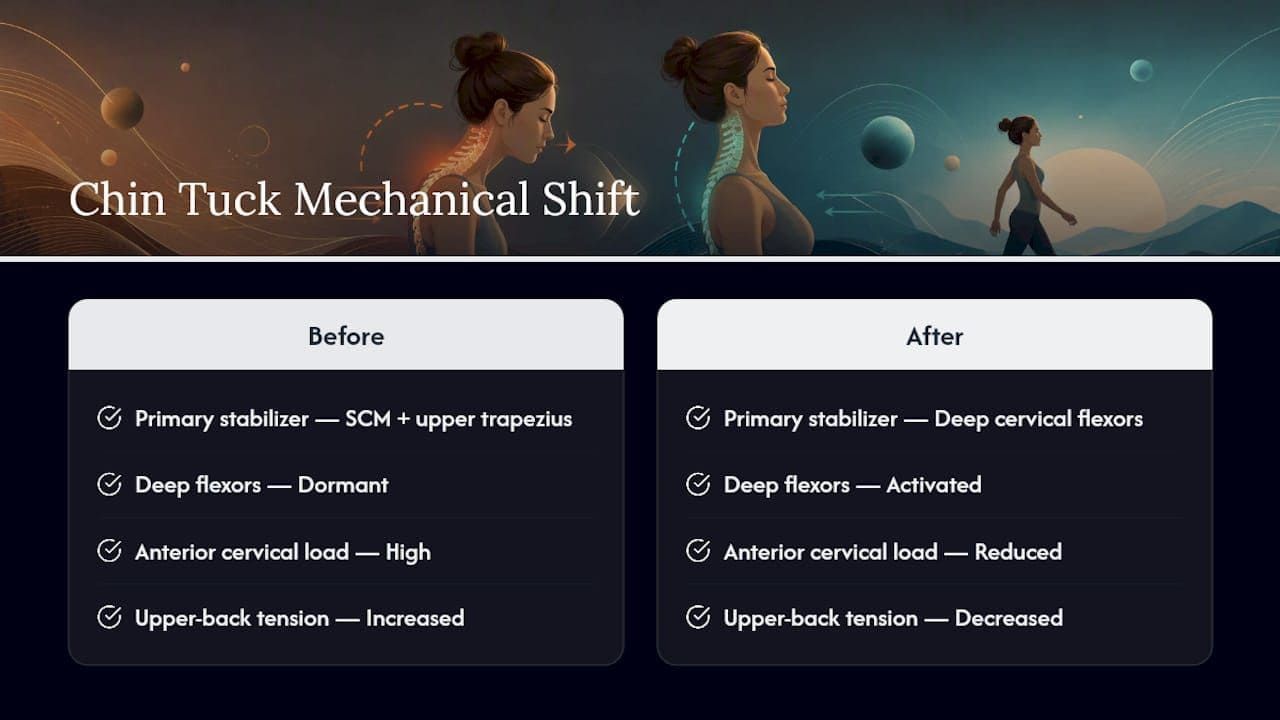
The mechanism is simpler than most people expect. Chin tucks target the deep cervical flexors, small muscles along the front of the spine that are supposed to hold your head steady but usually get bypassed in favor of the larger, more visible sternocleidomastoid (SCM) running along the side of your neck.
When the SCM and upper trapezius do all the work of holding your head up, especially in a forward-slouched position, they get overworked and tight. That's often the source of the nagging ache at the base of the skull. Chin tucks retrain the deep flexors to take over that stabilizing job, which reduces the anterior, or forward, load on the cervical spine. PT technique guides describe this as motor control work rather than strength training. You're not building bigger muscles. You're teaching dormant ones to fire on cue.
That shift often has knock-on effects. Less compensatory tension in the upper back and shoulders, and fewer of the tension headaches that stem from a chronically clenched neck and jaw.
How Do You Do a Chin Tuck Correctly?
Good form makes or breaks this exercise. Most people who say chin tucks "don't work" are actually doing a chin dip or a head nod instead of a true retraction.
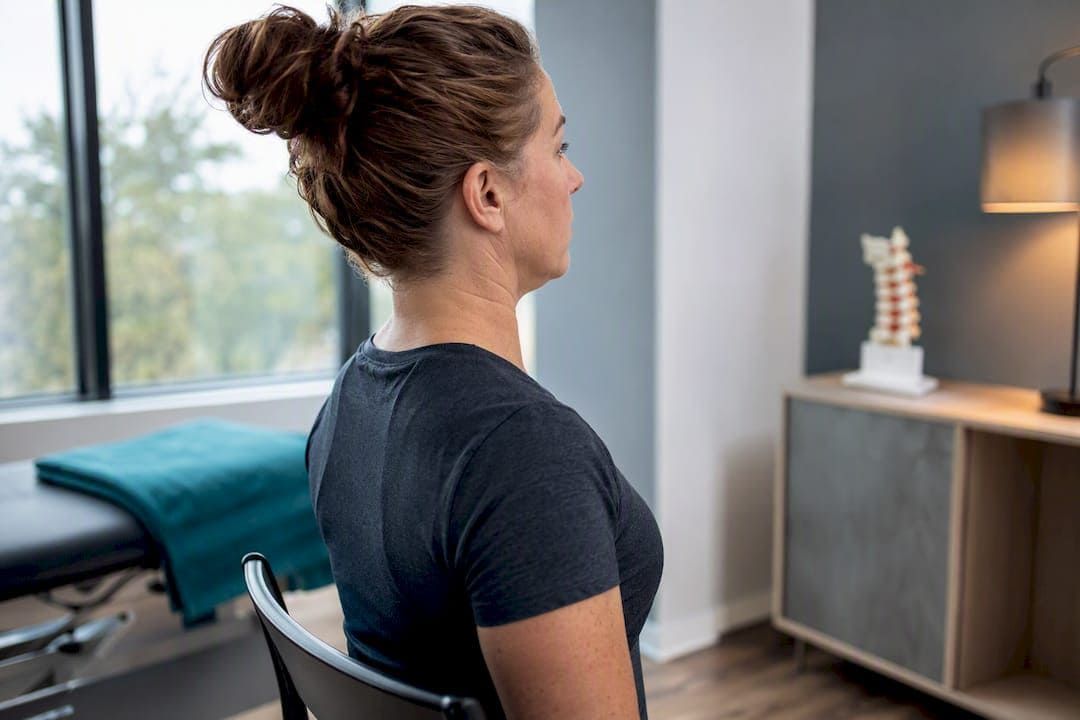
- Sit or stand tall with your shoulders relaxed and eyes level.
- Gently glide your head straight backward, as if sliding it along a shelf, without tilting your chin up or down.
- Keep your eyes forward the entire time. No tilting.
- Hold the position for 3 to 5 seconds, breathing normally.
- Release slowly back to a neutral position.
- Repeat for the prescribed number of reps.
The most common mistakes are jutting the jaw forward instead of gliding straight back, tilting the head up or down during the hold, holding the breath through the contraction, and overusing the neck's superficial muscles instead of the deep ones you're trying to train. Spine-Health's guidance stresses precision over range. A small, correct movement beats a big, sloppy one every time.
Pro Tip: You should feel a mild contraction at the base of the skull and the front of the throat, not strain or pressure. If your jaw or the front of your neck feels tight instead, you're likely dipping the chin instead of retracting it.
How Often Should You Do Chin Tucks?
Frequency matters more than intensity here. Clinical guidance generally favors short, frequent sessions spread across the day rather than one long workout.
- A common protocol: 5 to 7 sets of 10 repetitions spread throughout the day, per Spine-Health's exercise guidance.
- Other clinicians recommend 4 to 5 shorter sessions daily, especially for people glued to a desk.
- Some people notice relief within days. Measurable improvements in posture control and range of motion typically take 2 to 6 weeks of consistent practice.
Pair chin tucks with scapular retraction and upper-back mobility work for faster, more durable results. Doing chin tucks in isolation slows progress if the rest of your upper body is still slouched.
Who Should Avoid Chin Tucks or See a Clinician First?
Chin tucks are low-risk for most people, but they're not risk-free for everyone. Stop immediately and get assessed if you experience pain, numbness, or tingling radiating down an arm, new dizziness or lightheadedness, sharp or worsening pain instead of relief, or recent neck trauma such as a car accident or fall.
Anyone with progressive or radiating symptoms should get a professional evaluation before continuing, since those signs can point to nerve involvement that needs supervised care rather than a home exercise. If the standard version feels too intense, back off with regressions: smaller range of motion, performing the movement lying down with support under the head, or fewer reps per set until control improves.

What Does the Research Say About Chin Tucks?
The strongest evidence comes from a randomized controlled trial comparing three approaches to neck pain: sensorimotor training using the chin-tuck position, therapeutic stretching, and a general home exercise program. Over six weeks, the sensorimotor training group showed significantly larger drops in neck disability scores and greater gains in cervical range of motion than either comparison group.
Sensorimotor training built around the chin-tuck position produced meaningfully better outcomes on neck disability and mobility measures than stretching or standard home exercises over the same six-week window.
That distinction, sensorimotor training versus simple stretching, is worth sitting with. It suggests the value of chin tucks isn't really about flexibility. It's about retraining the brain's control over head position, according to the trial published in the Journal of the Korean Society of Physical Medicine. Clinicians generally prescribe chin tucks as one piece of a broader rehab plan, not a standalone fix, and the evidence base, while promising, is still limited to a handful of trials rather than a large body of research.
What Are Some Chin Tuck Variations and Progressions?
Once basic form feels automatic, you can scale the exercise up or down depending on your goals and current comfort level.
- Regression: A supine chin nod, lying on your back with a small pillow under the head, reduces gravity's demand and works well for beginners or flare-ups.
- Micro-range version: A smaller, gentler glide for anyone finding the full motion uncomfortable at first.
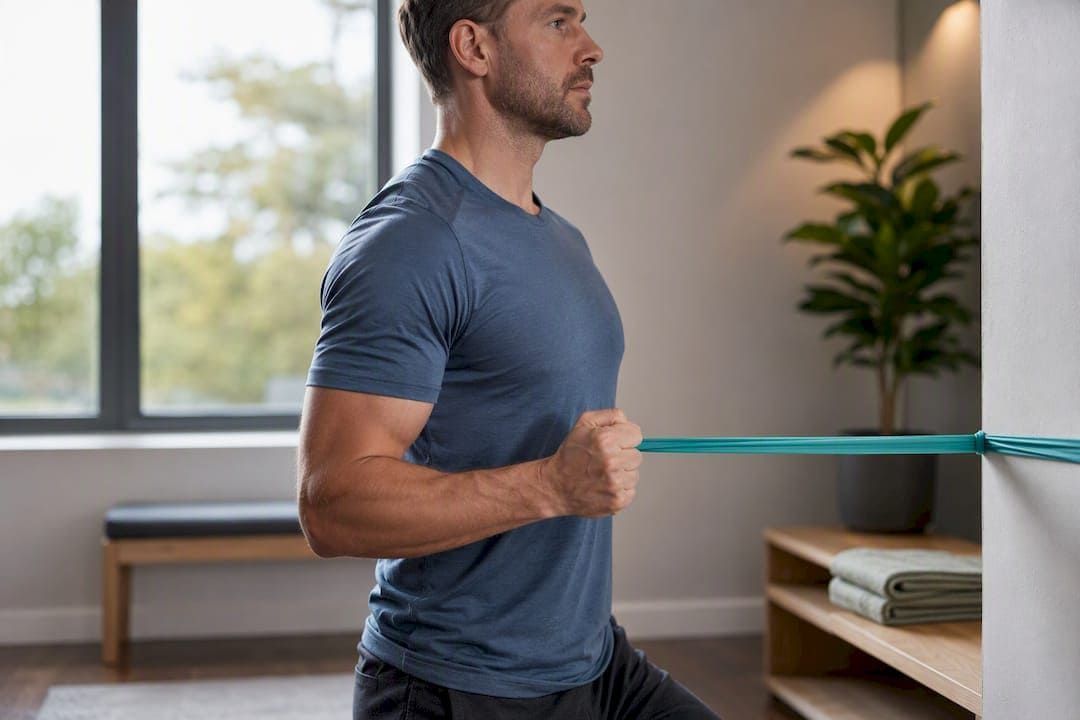
- Progression: Resistance band isometrics add load once the basic pattern feels effortless.
- Combination work: Pairing chin tucks with scapular retraction and thoracic mobility drills addresses the posture chain instead of just the neck.
A simple mini-routine: 10 chin tucks, 10 scapular retractions, and a minute of thoracic extension stretching, repeated two to three times daily. For more home-based pairings, Essentialchirocare's guide to home exercises that boost chiropractic results covers additional moves that complement this routine well.
A Clinician's View on Chin Tucks as a Rehab Tool
Chin tucks earn their reputation as a reliable habit-reset. They're an entry-level motor-control exercise, not a cure-all, and their real value is teaching your nervous system a better default head position before bigger problems set in.
When Chin Tucks Aren't Enough, What's the Next Step?
Chin tucks work well as a self-directed starting point, but they have limits. If your neck pain persists past a few weeks, radiates into your arm, or traces back to an accident or old injury, a home exercise alone won't address what's driving it. That's when a clinical assessment matters more than another set of reps.
Clinicians build on sensorimotor training supported by research, offering hands-on assessment to determine whether your neck pain is muscular, postural, or related to other causes, like disc involvement or old whiplash. Our physical rehab programs use supervised, progressive exercise plans rather than one-size-fits-all handouts, and our chiropractic care team includes doctors with backgrounds treating sports teams across West Central Florida. If chin tucks have plateaued or your pain keeps coming back, consider a clinical assessment to find out what's actually driving it.
This article is general information, not a substitute for advice from a qualified doctor. Consult a qualified healthcare professional about your own circumstances before acting on anything here.
Sources
FAQ
Do Chin Tuck Exercises Actually Work?
Yes, for posture-related neck pain and stiffness, chin tucks have real support behind them. A randomized trial found that sensorimotor training using the chin-tuck position reduced neck disability scores and improved range of motion more than stretching alone over six weeks.
Can Chin Tucks Improve Your Jawline?
Chin tucks may offer a modest firming effect on the muscles under the chin, but they're not a jawline-sculpting exercise. They won't reduce fat or reshape bone structure, so treat any cosmetic improvement as a side effect, not the goal.
How Long Should You Do Chin Tuck Exercises?
Most clinical guidance recommends short daily practice indefinitely if you have a desk job or chronic forward head posture, since the benefit fades if you stop. A typical protocol runs 5 to 7 sets of 10 reps spread across the day.
How Long Does It Take to See Results From Chin Tucks?
Some people feel relief within days of starting, especially if tension headaches were tied to forward head posture. Measurable improvements in posture control and neck mobility generally take 2 to 6 weeks of consistent, correctly performed practice.