Phased Clinician Rotator Cuff Tendinopathy Exercises for Stability
Phased Clinician Rotator Cuff Tendinopathy Exercises for Stability
A phased approach works best: restore pain-free range of motion first, then build endurance in the rotator cuff and scapular muscles with high-repetition, low-resistance training. Start with pendulum swings and gentle stretching daily. Add resistance band work only once your shoulder moves through most of its arc without sharp pain, and stop immediately if you feel a sharp or pinching sensation rather than the dull ache of normal muscle fatigue.
TL;DR:
- Start mobility exercises like pendulum swings early, ensuring shoulder motion is pain-free before progressing to resistance band work.
- Avoid resistance training if sharp pain or sudden discomfort occurs, and focus on daily stretching and posture correction throughout recovery.
- Expect rehabilitation to take four to six weeks, with objective progress markers such as active range of motion and reps at low resistance guiding program advancement.
- Strengthening should focus on endurance rather than bulk, emphasizing high-repetition, low-resistance work for shoulder stabilizer muscles.
- Seek clinical evaluation if pain worsens, persists beyond two months, or if progress stalls despite consistent adherence to the home program.
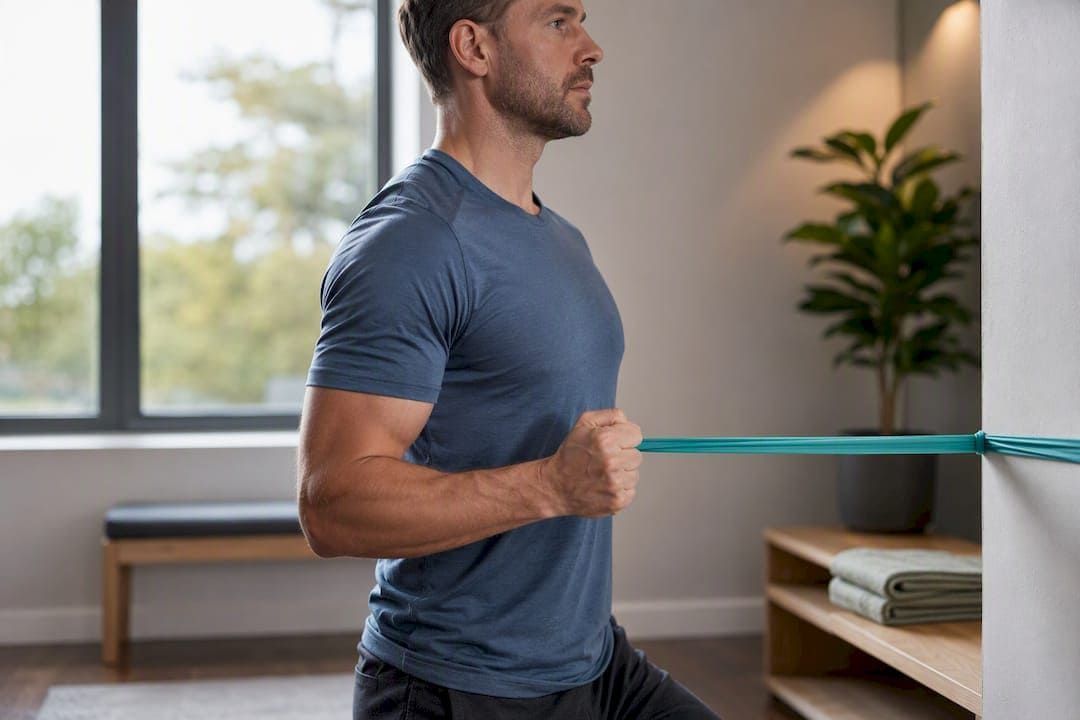
Table of Contents
- Getting Started With Rotator Cuff Tendinopathy Exercises
- Mobility Drills That Restore Pain-Free Range Of Motion
- Rotator Cuff Strengthening: Building Endurance, Not Bulk
- How Long Does Rotator Cuff Rehab Take?
- When Should You Stop Exercising Due to Pain?
- What the Research and Clinical Guidelines Say
- A Clinic's View on Translating This Into Real Recovery
- A Clinician's Note on Recovery Expectations
- When Supervised Care Makes Sense
- Authoritative Resources for Protocols and Evidence
- Sources
- FAQ
Getting Started With Rotator Cuff Tendinopathy Exercises
Before you do a single rep, run through a quick self-check. Sharp, radiating pain, numbness or tingling down the arm, noticeable weakness lifting everyday objects, or shoulder pain that wakes you up at night are signs this needs a clinician's eyes before a home program, not after. Rotator cuff tendinopathy typically shows up as a dull, deep ache with certain movements, especially reaching overhead or behind the back, along with stiffness and a gradual loss of strength rather than sudden, dramatic pain. That distinction matters when you're deciding whether to start exercising or pick up the phone first.
Once you've cleared that check, warm up. Five to ten minutes of light cardio, a brisk walk, arm circles, or even a warm shower, increases blood flow to the shoulder capsule and makes the tissue more pliable before you stretch it. Skipping this step is one of the most common reasons people feel worse after a session that should have helped.
Posture matters more than most people expect. A forward-rounded shoulder position shortens the chest muscles and lengthens the muscles between your shoulder blades, which changes how the rotator cuff tendons track under the shoulder blade's bony arch. Checking in on shoulder posture throughout the day, not just during exercise, reduces the mechanical irritation that keeps tendinopathy flaring.
You don't need a gym. A basic home setup covers nearly every exercise in this guide:
- A light resistance band (light to medium tension bands suitable for gentle resistance)
- A one-pound to three-pound dumbbell, or a full soup can as a substitute
- A cane, broomstick, or yardstick for assisted stretching
- A hand towel for sleeper stretches
- A stable, armless chair for seated rows
Overuse from repetitive overhead activity, whether that's swimming, painting, or years of manual labor, is one of the most frequent drivers of this condition, and understanding those overuse patterns helps you avoid recreating the problem once your shoulder feels better.
Mobility Drills That Restore Pain-Free Range Of Motion
Every rehab protocol for rotator cuff tendinopathy starts the same way: motion before strength. Loading a stiff, guarded shoulder with resistance bands before it can move freely tends to backfire, driving compensations at the neck and shoulder blade that create new problems on top of the old one.
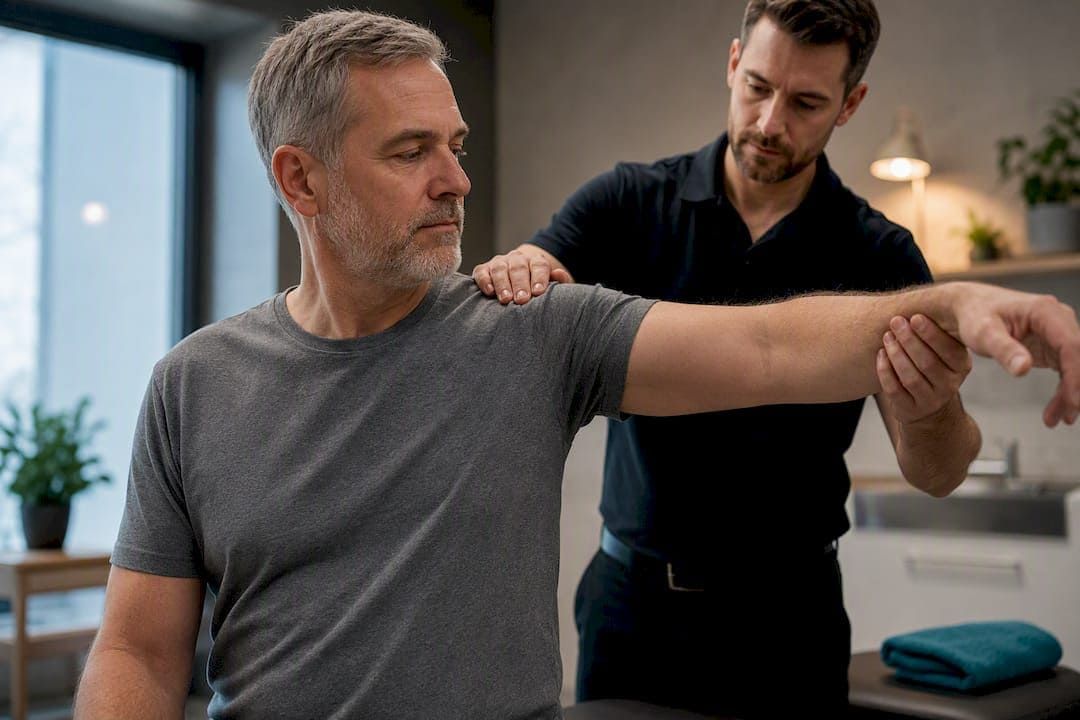
Pendulum (Codman) exercise. Lean forward, bracing your uninvolved arm on a table or chair, and let the affected arm hang loose toward the floor. Gently swing it in small circles, forward and back, and side to side, using body momentum rather than shoulder muscles to drive the movement. Do 10 to 15 swings in each direction, once or twice daily, especially in the acute, painful phase. This is often the first exercise clinicians give patients because it moves the joint without asking the injured tendons to actively contract.
- Posterior crossover stretch. Bring the affected arm across your chest at shoulder height, using the other hand to gently pull it closer. Hold 20 to 30 seconds, repeating several times as advised. This targets the back of the shoulder capsule, which tightens up in almost everyone with chronic cuff irritation.
- Hand-up-back stretch. Reach the affected arm behind your back, as if reaching for a rear pocket, and use the other hand or a towel to gently increase the stretch. Hold 20 to 30 seconds, repeating several times as advised. Stop well short of pain; this motion loads the front of the shoulder in a way that flares many people if pushed.
- Sleeper stretch. Lie on the affected side with the shoulder at 90 degrees and elbow bent. Use your other hand to gently press the forearm down toward the table. Hold 20 to 30 seconds, repeating a few times as advised. This one specifically addresses internal rotation deficits common in overhead athletes and desk workers alike.
- Wand or cane assisted flexion. Lying on your back, hold a cane with both hands and use the unaffected arm to lift the injured arm overhead, staying inside a pain-free arc. 10 reps, once or twice daily.
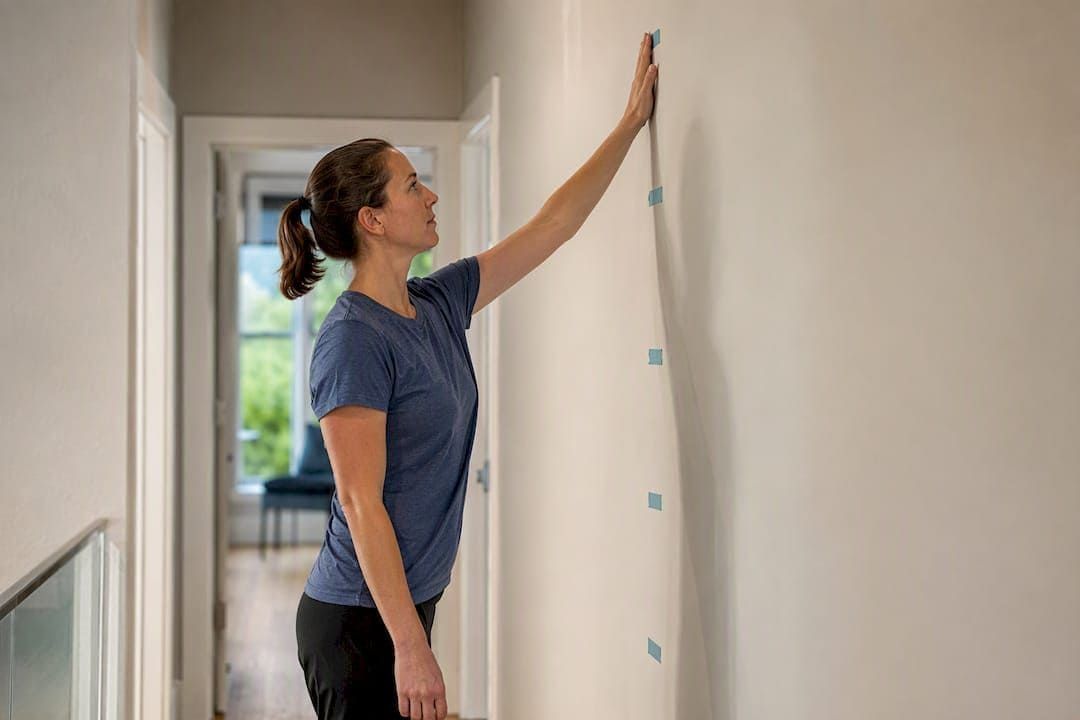
- Wall climb. Facing a wall, walk your fingers upward as high as comfortable, hold briefly, then walk back down. This gives you a visual, trackable measure of progress week to week.
Do these stretches daily, ideally once in the morning and once in the evening, according to the exercise dosing patient guidance from HSS commonly used in conservative shoulder care. A mild pulling sensation or a 2 out of 10 discomfort is expected and fine. A sharp or electric feeling is your cue to back off the range immediately.
Pro Tip: Track your wall climb height with a piece of tape each week. Watching that mark creep upward is more motivating than any pain scale, and it gives you and your clinician an objective marker of progress.
Rotator Cuff Strengthening: Building Endurance, Not Bulk
Strength work only starts once the mobility drills above no longer provoke sharp pain and your active range is close to full. This is the phase where a lot of home programs go wrong, either by starting too aggressively or by skipping the small stabilizer muscles entirely in favor of exercises that feel more productive.
Rotator cuff muscles, the supraspinatus, infraspinatus, teres minor, and subscapularis, are small, endurance-oriented muscles built for postural control and joint stability, not raw power. Therapists generally favor higher-repetition, low-resistance band training for these muscles rather than the heavy, low-rep loading used for larger prime movers like the chest or lats. Training them like a bodybuilder trains biceps tends to aggravate irritated tendons rather than strengthen them.
Phase 1: Isometrics for the painful stage
If active motion is still uncomfortable but you've cleared the red-flag checklist, isometric holds are usually the safe entry point. Press your hand into a wall or doorframe in the direction of internal rotation, external rotation, and forward flexion, holding each for 10 to 15 seconds without any joint movement. Do several repetitions in each direction, once or twice daily. Because there's no motion at the joint, isometrics let you load the tendon without provoking the pain that comes from moving through an irritated arc.
Phase 2: Band-based isotonic strengthening
- External rotation with band. Anchor a band at elbow height, elbow tucked to your side and bent 90 degrees, and rotate the forearm outward against the band's resistance. 2 to 3 sets of 10 to 15 reps.
- Internal rotation with band. Same setup, rotating the forearm inward across your body. Match the sets and reps of external rotation to avoid building an imbalance between the two.
- Scapular retraction. Hold the band in both hands at chest height and pull your shoulder blades together, pausing 2 seconds at the squeeze. 2 to 3 sets of 12 to 15 reps.
- Seated rows. Anchor the band at chest height, sit tall, and pull the handles toward your ribs, squeezing the shoulder blades down and back. 2 to 3 sets of 12 reps.
- Prone horizontal abduction. Lying face down with your arm hanging off a bed or bench, lift it straight out to the side to shoulder height, thumb pointed up. 2 sets of 10 to 12 reps.
- Shoulder blade squeezes. No equipment needed. Simply pull the shoulder blades together and hold 5 seconds, repeated 10 to 15 times, several times a day if desk posture is a factor.
Scapular strength gets overlooked constantly, and that's a mistake. Clinical guidance on shoulder rehab points to restoring scapulothoracic stability as essential protection for the rotator cuff, since a shoulder blade that doesn't stabilize properly forces the smaller cuff muscles to compensate for larger movement patterns they weren't built to control. Skipping straight to rotation exercises while ignoring rows and retraction work is one of the most common reasons people plateau.
Dosing follows a consistent pattern across clinical handouts: light band tension, high reps (12 to 15 per set), and a frequency of three sessions per week, with a rest day between sessions to let the tendon adapt. Stretching stays daily throughout this entire phase; strengthening does not.
Pro Tip: If you can't complete 10 clean reps without your shoulder hiking up toward your ear, the band is too heavy. Drop tension before you drop form. Compensating with the upper trap muscle is exactly the pattern this program is trying to undo.
Progress the resistance only when a set of 15 reps feels genuinely easy, moving to the next band color or a slightly heavier can. Jumping two levels at once, or adding weight because you're feeling impatient rather than because the current level is easy, is the single fastest way to trigger a setback in this phase.
How Long Does Rotator Cuff Rehab Take?
Most structured programs run four to six weeks before a meaningful reassessment, matching the conditioning timeline recommended by AAOS's OrthoInfo shoulder program. That doesn't mean everyone is pain-free by week six. It means that's the point where you and a clinician should look at objective progress and decide whether to advance, hold steady, or adjust the plan.
Before adding resistance or moving to more demanding exercises, you want to hit a few checkpoints: active range of motion close to full and roughly symmetrical with the uninjured side, minimal shoulder-hike or trunk-lean compensation during band work, and the ability to complete 30 reps at your current low resistance with clean form. Those objective checks matter more than the calendar. Two people starting the same week can be ready to progress two weeks apart.
A typical week in the strengthening phase looks like this:
| Day | Focus |
|---|---|
| Monday | Stretching routine + strengthening session 1 |
| Tuesday | Stretching routine only |
| Wednesday | Stretching routine + strengthening session 2 |
| Thursday | Stretching routine only |
| Friday | Stretching routine + strengthening session 3 |
| Saturday | Stretching routine only |
| Sunday | Rest or light pendulum swings if stiff |
Once you're consistently hitting those progression markers, you can layer in more advanced, functional movements: scaption (raising the arm at a 30 degree angle from straight out to the side, thumb up), push-up plus against a wall or counter to fire the serratus anterior, and long-lever tasks like carrying a light bag away from your body. These ask more of the whole shoulder complex working together, which is exactly what daily activities and sports demand once you're past the acute phase. Reviewing therapeutic exercise progressions at this stage helps confirm you're advancing at a pace your tendon can actually tolerate.
When Should You Stop Exercising Due to Pain?
Soreness and sharp pain are not the same signal, and confusing them is where a lot of home programs go sideways. A dull ache during or shortly after exercise, similar to how a muscle feels the day after a new workout, is generally an acceptable response and doesn't mean you're causing damage. A sharp, stabbing, or electric sensation is different. That's your cue to stop the exercise immediately and reassess your form, range, or resistance level before trying again.
Clinicians generally advise against pushing through sharp pain in the hope it will "work itself out," since Harvard Health's guidance on rotator cuff tendonitis frames pain explicitly as a guide, not an obstacle to override. If mild soreness shows up after a session, ice for 15 to 20 minutes is a reasonable way to manage it. Relying on pain medication to push through more volume than your shoulder can currently tolerate just masks the signal you're supposed to be listening to.
A few situations call for a clinician's evaluation rather than more home exercise:
- Pain that worsens week over week instead of gradually easing
- Night pain severe enough to disrupt sleep
- New or increasing weakness, especially lifting the arm overhead
- Numbness, tingling, or a burning sensation radiating down the arm
- No meaningful improvement after 6 to 8 weeks of consistent, correctly performed exercise
That last point matters because plenty of people quietly grind through a plateau for months, assuming they just need to try harder. A structured physical therapy approach can identify whether the issue is a technique problem, a tear that needs imaging, or simply a program that needs to be adjusted.
What the Research and Clinical Guidelines Say
The clinical case for exercise in rotator cuff tendinopathy isn't just conventional wisdom passed down between physical therapists. A systematic review published through NIH's PMC database found that exercise-based therapy reduces pain and improves function across a range of trial designs, though the reviewed studies varied meaningfully in program length, exercise selection, and dosing protocols.
That variability is worth sitting with for a second. It means there's no single universally "correct" set of exercises, but there is strong, consistent agreement on the underlying structure: restore motion, then build endurance-based strength, then progress function. That's precisely the sequence AAOS's OrthoInfo conditioning program lays out for patients, calling for daily range-of-motion and stretching work, followed by progressive strengthening two to three times per week, typically over a four to six week conditioning window.
Objective progression checkpoints, near-normal pain-free active motion and the ability to perform around 30 reps at low resistance with good form, come from that same OrthoInfo framework and give both patients and clinicians a shared, measurable standard instead of a vague sense of "feeling better."
None of this means every case fits the same template. Larger or full-thickness tears, calcific tendinopathy, and cases with significant weakness on exam often need individualized programming, imaging, or additional interventions beyond a standard home routine. The research supports exercise as a first-line, evidence-backed approach for most tendinopathy presentations. It doesn't claim to be the answer for every shoulder walking through the door.
A Clinic's View on Translating This Into Real Recovery
Exercise prescription rarely stands alone. Manual therapy, joint mobilization, and soft tissue work often run alongside a home stretching and strengthening program, addressing the stiffness and joint mechanics that exercise by itself can be slow to resolve. A shoulder that's been guarded for months frequently has capsular tightness that responds faster to hands-on treatment than to stretching alone.
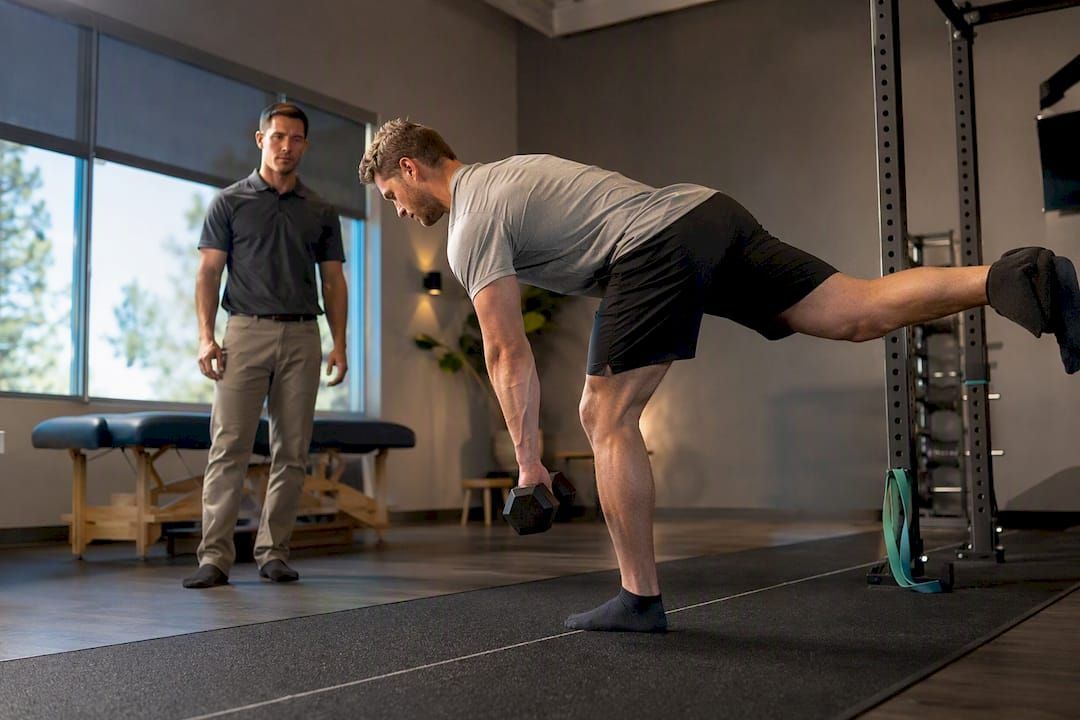
Some clinicians bring backgrounds working with athletic populations, which shapes how progression decisions get made, particularly around when to advance resistance versus when to hold a patient at isometrics longer.
If you've been working through pendulum swings and band exercises for a few weeks without meaningful change, that's typically the point where an in-person evaluation adds more value than another week of guessing. A clinical assessment can confirm whether your program needs more time, a different exercise selection, or manual therapy layered in to address what exercise alone hasn't reached yet.
A Clinician's Note on Recovery Expectations
Consistency beats intensity, every time, in this kind of rehab. A shoulder that gets five short sessions a week improves faster and more reliably than one that gets one long, aggressive session on the weekend. Tendons adapt to frequent, modest stress far better than to occasional, heavy stress, and "binge" sessions after a few days off are one of the most reliable ways to trigger a flare.
The two mistakes I see most often: starting band strengthening before motion is actually pain-free, and skipping scapular work because rotation exercises feel more directly relevant to the injury. Both tend to stall progress in ways that feel confusing from the inside, because the exercises being done "correctly" just aren't the right exercises yet.
If you've followed a program faithfully for six to eight weeks without real change, that's not a sign to push harder. It's a sign to get a second set of eyes on what's happening.
When Supervised Care Makes Sense
A home program handles a lot of rotator cuff tendinopathy cases well, but it isn't the only option, and it isn't always the fastest path back to full use of your shoulder. When pain persists past the six to eight week mark, or when you're not confident you're doing the exercises correctly, Essential ChiroCare offers what a printed handout can't: a clinical evaluation that pinpoints exactly where your program needs to change.
A first visit typically includes a hands-on assessment of your shoulder's range, strength, and movement patterns, followed by a tailored plan that pairs manual therapy with a progressive exercise prescription built around where your shoulder actually is, not a generic timeline. For cases tied to sports or repetitive strain, the clinic's sports injury care draws on doctors' backgrounds working with athletic teams. If you're ready to stop guessing whether you're doing this right, schedule a physical rehab evaluation with Essential ChiroCare and get a plan built around your shoulder specifically.
Authoritative Resources for Protocols and Evidence
- AAOS OrthoInfo conditioning program: phased protocol and progression milestones
- NIH PMC systematic review: evidence on exercise efficacy
- HSS patient guidance: symptom and dosing overview
- MedlinePlus exercise instructions: step-by-step home exercise cues
- Mayo Clinic exercise images: visual form reference
This article is general information, not a substitute for advice from a qualified doctor. Consult a qualified healthcare professional about your own circumstances before acting on anything here.
Sources
FAQ
How do you fix rotator cuff tendinopathy?
Most cases improve with a phased exercise program: daily mobility and stretching first, followed by endurance-based strengthening of the rotator cuff and scapular muscles three times a week once motion is close to pain-free. Manual therapy and clinical guidance help when progress stalls or motion stays limited.
What should you avoid with rotator cuff tendinopathy?
Avoid pushing through sharp or stabbing pain, starting resistance training before your range of motion is close to normal, and skipping scapular stabilization work in favor of rotation exercises alone. Heavy, low-rep loading also tends to aggravate these small stabilizer muscles rather than strengthen them.
Does rotator cuff tendinopathy go away on its own?
Some mild cases ease with rest and activity modification, but structured exercise consistently produces better and faster results than waiting it out, according to NIH-reviewed trial evidence. Cases that show no improvement after 6 to 8 weeks usually need a clinical evaluation rather than more time alone.
What is the most common cause of rotator cuff tendinopathy?
Repetitive overhead activity and overuse, whether from sports, manual labor, or repeated reaching, are among the most frequent drivers, often combined with poor scapular and postural control that adds mechanical strain on the tendons over time.
How often should I do rotator cuff strengthening exercises?
Strengthening exercises are typically done three times a week with a rest day between sessions, while stretching and mobility work continues daily throughout the program, following the dosing pattern used in standard conservative shoulder care.
Recommended